Tag: Money

  • The Future Of Money – Digital Rupee

    The Future Of Money – Digital Rupee

    Experience The Future Of Money With Digital Rupee – India’s First Digital Currency!

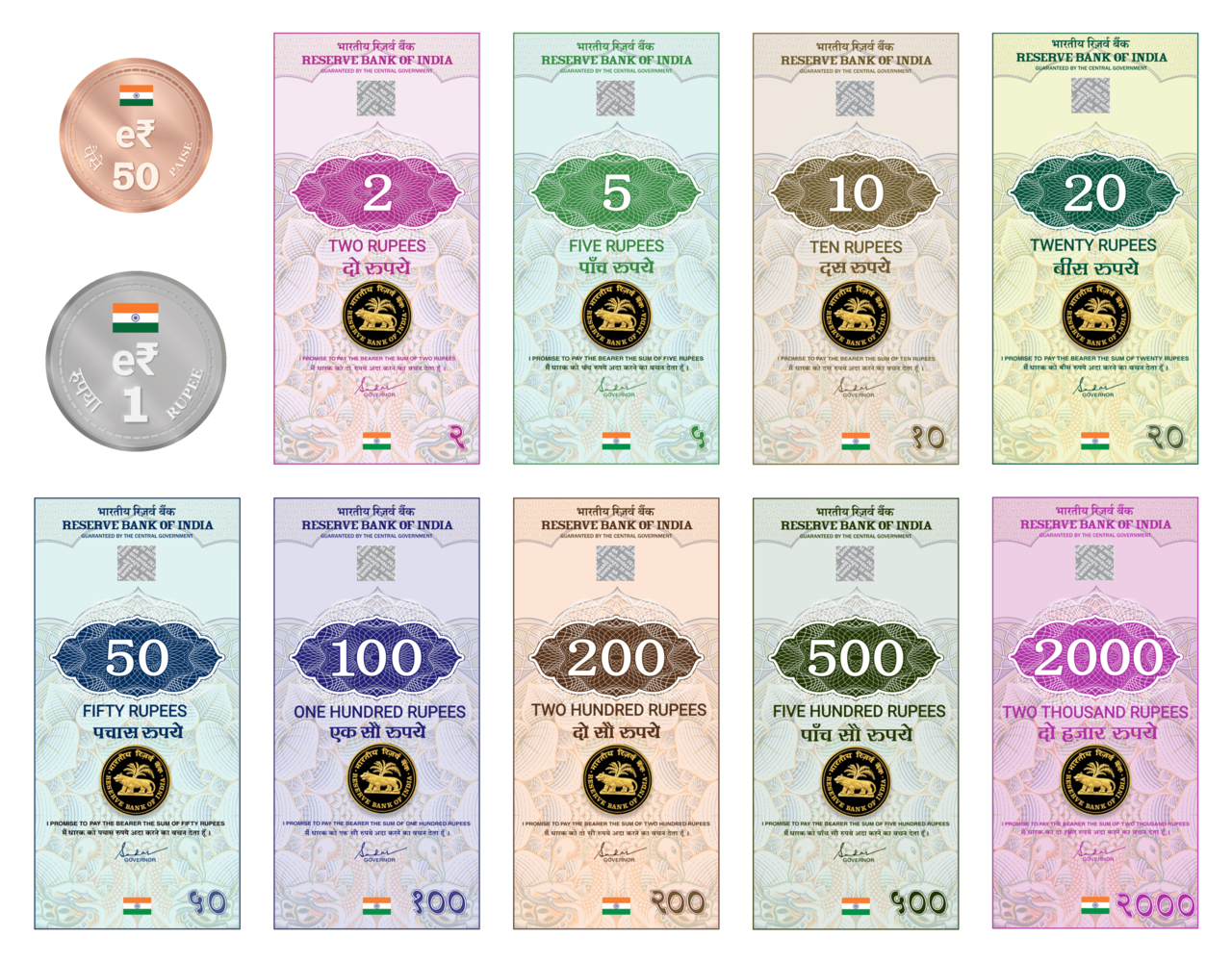
    Digital Rupee app is a e₹ wallet application that enables users to conduct transactions using Digital Rupee tokens. It can be used to pay for goods & services and send money to anyone in form of digital currency.

    Digital Rupee is the legal tender issued by RBI in a digital form – It is equivalent to our sovereign paper currency. It is a legal tender and an accepted medium of payment in India – since backed by Government and RBI.

    Based on Blockchain Technology, it is secure, fast and real-time. Since it is a digital currency, it’s always on – instant and convenient way of making and receiving payment. Heartening to note that India continues to spearhead the payments revolution – as we march towards a digital and cashless society!

    All leading banks including ICICI, Kotak have their Digital Currency Apps! Try Digital Rupee App today – Celebrate the festival of wealth Dhanteras and festival of lights Diwali in an unique way!


  • The Future Of Fintech

    The Future Of Fintech

    Technological changes and overall trends are often difficult to predict. What seems as the obvious future often fails to deliver, and new innovations take over! Look around and many of the technological tools that we take for granted, were never predicted…The Fintech world continues to present new ideas, solutions and business models.

    The future of Fintech, money and payments is linked to the evolution of the society. In next 10-20 years, we may see the emergence of robots, machine to machine interaction, smart cities, universal basic economy, ageing population, climate change and prosperous mankind.

    In that age, payments between machines will be automatic and invisible. Cashless economy will be a reality with secure, invisible, hyper-connected, data-driven money and payment system becoming a backbone like internet and electricity.

    Payments will be integrated as a part of buying experience. Pricing and offers will be specific to you as per your financial score. Secure micro-payments will be order of the day. Micro-payments will also mean more access to everyone.

    Technological innovations in payment will allow the remaining less-privileged to get access to basic income and help from across the world. The credit scoring, mortgage options etc. all will be seamless and real-time.

    Property will be tokenized. Agricultural land will be tokenized. Equity tokenization will unlock liquidity. Blockchain will be leveraged for tokenization in the future and new business models will emerge. Privacy, legal and security frameworks will ensure the required safeguards.

    Quick and easy barter mechanisms will become an alternative to the money economy.

    The cumulative effect will be help unbanked and underbanked individuals and SMEs to get benefits of the financial system and accelerate job creation, equitable and balanced economic growth.

    Image Credit: Joshua Reddekopp on Unsplash

  • Dilbert’s Simple 9 Point Investment Plan

    Dilbert’s Simple 9 Point Investment Plan

    Financial Planning and Money is a very important subject. One one hand, people are very casual about this and on the other hand, they over-analyze with complex books and expert advice and long formulas.

    Simplicity is often not given the merit it deserves. Dilbert’s Scott Adam has curated the investment wisdom and put it in a simple 9 point plan. And it is very powerful indeed.

    Here are the Scott Adam’s 9 Point Investment Plan:

    1. Make a will

    2. Pay off your credit cards

    3. Get term life insurance if you have a family to support

    4. Fund your 401k to the maximum

    5. Fund your IRA to the maximum

    6. Buy a house if you want to live in a house and can afford it

    7. Put six months worth of expenses in a money-market account

    8. Take whatever money is left over and invest 70% in a stock index fund and 30% in a bond fund through any discount broker and never touch it until retirement

    9. If any of this confuses you, or you have something special going on (retirement, college planning, tax issues), hire a fee-based financial planner, not one who charges a percentage of your portfolio

    One has to follow the above in the step by step by order. The Indian equivalent of 401K and IRA would be PPF and EPF – not 100% same by near.

  • FinTip – Top 3 Reasons To Buy IDFC Bonds

    In this year’s annual budget, Finance Minister had introduced a new tax saving deduction – Sec CCF. It was INR 20,000 for investment made into special infrastructure bonds.

    Now, Infrastructure Development Finance Co (IDFC) has launched these bonds. The issue opens for subscription on Thursday, September 30, and closes on Monday, October 18.

    I recommend it. I am no Tax Guru. I have 000 Patents in Finance. But here is my reasoning:

    1. The tax deduction is over and above your 1 lakh deduction under Sec 80C.
    2. The rate of interest is in the range of 7.5 – 8%. But the real return on the bonds is much higher, it you consider the tax deduction.
    3. Rating agency ICRA has given the IDFC bonds an LAAA 
rating, which is the highest rating that an infra bond can get.

    Though one can invest more than 20,000 in these bonds, one can claim tax deduction on a maximum of INR 20,000 only. But, Money saved is money earned. Another interesting reason to save !