Category: Reading & Learning

  • Subroto Bagchi’s Sell: Rich Insights For Technology Sales

    Subroto Bagchi’s Sell: Rich Insights For Technology Sales

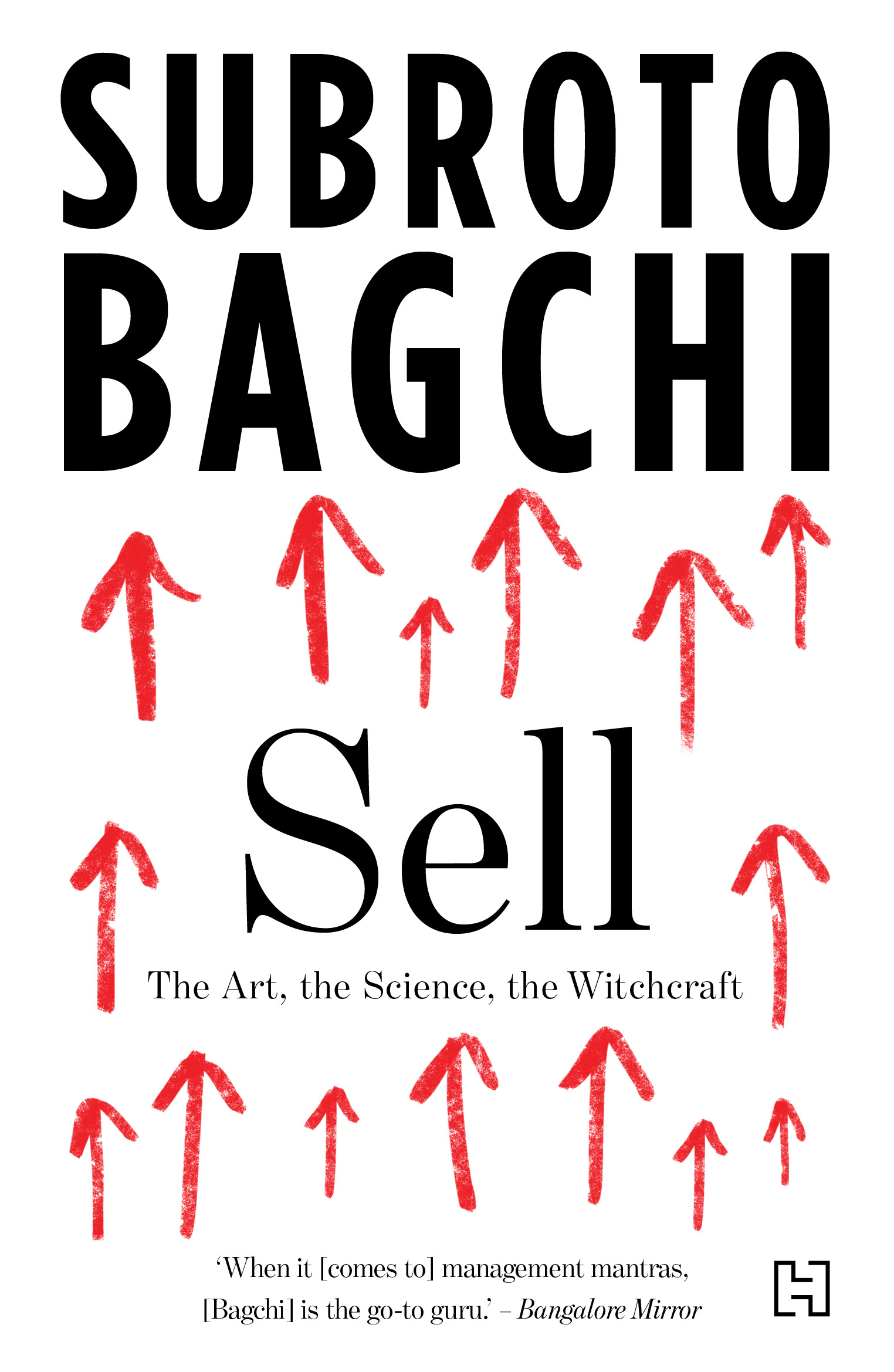
    Selling is a challenging profession and a very demanding one as well! Selling today is a different ball game with the buyer being more knowledgeable and smart. A buyer would have done a thorough research on us before actually interacting with us. A lot of activities in the sales process are getting digital and a smart sales person needs to understand this shift. Even Artificial Intelligence will invade sales area. So how does one deal with these changes? What are the best practices in technology sales? Unfortunately, there are few sources and books on technology selling that can provide insights and shared experiences. Mindtree Co-founder Subroto Bagchi tries to address this gap and provide his rich insights on selling.

    Many of Subroto’s fans and friends like me were awaiting his new book – since a lot of water had flown in Ganges since the release of his previous book. And ever since he told me that his upcoming book was on sales, the salesman in me was eager to lay his hands on the book.

    ‘Sell: The Art, Science, the Witchcraft’ is the title of SubrotoDa’s book and it brings together the experience and advice of various sales leaders. Subroto has known these sales leaders and drawn on their unique sales philosophy and wisdom. There are nice anecdotes, unique insights and practical tips.

    SubrotoDa defines sales as part science, part art and part wizardry. It is not a profession in itself but a very critical skill in every field and an essential skill for people across all levels within the organization. Selling is not something to be apologetic about. It is not a pushy, winner-take-all masculine act. It is an empathy-led, process-driven and knowledge-intensive discipline.

    A lot of things in Sell impressed me – visual design of technological solution, collaboration between sales and marketing for larger deals, response to a major RFP loss, Google Quotient, The Naked Burger, Do It Like Swedes etc. I definitely intend to influence my sales practices with some of these thoughts.

    He uses the analogy of life-cycle of Coho salmon to drive home the importance of right prospecting by segmenting the customers and figuring out the right hook. Right qualification is importance to save the most precious resource of salesperson: time. And also ensure optimization of organizational energy, effort, intellect and other resources. I smiled at the different stereotypes presented: Great giver of homework, patron saint of thought leadership etc.

    He has some stellar lines for us:
    – Authenticity is in short; hence in demand
    – The prospecting process has changed. Your future customers are already doing prospecting about you and your company

    Honesty, transparency, customer relationship, negotiation, etc. are important traits for an effective seller and Subroto delves into each of these topics. Customer relationship is a competitive advantage and one has to developer chemistry with the customer. He emphasizes one thing that has not changed in sales – people buy from people. A best sales person is a consultant who advises client and brings teams together to create the right solution and sell in a consultative approach.

    Subroto also delves into areas of deal-making, legal support, paperwork etc. He ends the book with detailing of what a makes a true sales champion.

    Subroto delivers his rich intellect and wisdom in easy to understand nuggets. He has strong rationale for his views. I had whole-heartedly followed his advice of uprooting ourselves and exploring new geographies to break our comfort zone and rewire our thinking.

    Could this have been even a greater book? Would have I liked anything more in this book? Yes – Some more depth on some topics (I understand the overall writing style of Subroto). I would have liked to see the comparative analysis of selling practices of Indian IT and true blue Western IT companies. Maybe some detailed case studies of winning a large and complex enterprise deal – without divulging confidentiality of any entities. Maybe some biggest sales follies of the sales leaders. I would also have loved to see his views on how the new and mid-sized Indian companies can win deals in the new emerging global landscape. This would have been a great service to many emerging sales leaders.

    Sell is a great resource for technology sales professionals. It is a great addition to the dearth of Indian voice on this topic. It has nice insights for sales professional. Read it!

  • If

    If

    English poets have produced some remarkable work and “If” is one of the great gems. British Nobel laureate Rudyar Kipling’s poem was written in 1895 and published in “Rewards & Fairies” in 1910.

    “If” remains one of the most beautiful advice and inspirational gem. One can find glimpses of Bhagwad Gita, Vedic & Natural wisdom in this poem.

    Though the whole work is awesome, some of my favorites lines are:

    1. If you can trust yourself when all men doubt you,
    But make allowance for their doubting too;

    2. If you can dream—and not make dreams your master;
    If you can think—and not make thoughts your aim;

    3. If you can meet with Triumph and Disaster
    And treat those two impostors just the same;
    (Like Sthitaprajna in Bhagwad Gita)

    4. If you can talk with crowds and keep your virtue,
    Or walk with Kings—nor lose the common touch,

    “If”

    If you can keep your head when all about you
    Are losing theirs and blaming it on you,
    If you can trust yourself when all men doubt you,
    But make allowance for their doubting too;
    If you can wait and not be tired by waiting,
    Or being lied about, don’t deal in lies,
    Or being hated, don’t give way to hating,
    And yet don’t look too good, nor talk too wise:

    If you can dream—and not make dreams your master;
    If you can think—and not make thoughts your aim;
    If you can meet with Triumph and Disaster
    And treat those two impostors just the same;
    If you can bear to hear the truth you’ve spoken
    Twisted by knaves to make a trap for fools,
    Or watch the things you gave your life to, broken,
    And stoop and build ’em up with worn-out tools:

    If you can make one heap of all your winnings
    And risk it on one turn of pitch-and-toss,
    And lose, and start again at your beginnings
    And never breathe a word about your loss;
    If you can force your heart and nerve and sinew
    To serve your turn long after they are gone,
    And so hold on when there is nothing in you
    Except the Will which says to them: ‘Hold on!’

    If you can talk with crowds and keep your virtue,
    Or walk with Kings—nor lose the common touch,
    If neither foes nor loving friends can hurt you,
    If all men count with you, but none too much;
    If you can fill the unforgiving minute
    With sixty seconds’ worth of distance run,
    Yours is the Earth and everything that’s in it,
    And—which is more—you’ll be a Man, my son!

  • Avoiding Sep 11 Attacks, Happy Marriage Equation & Better Thinking Ideas

    Avoiding Sep 11 Attacks, Happy Marriage Equation & Better Thinking Ideas

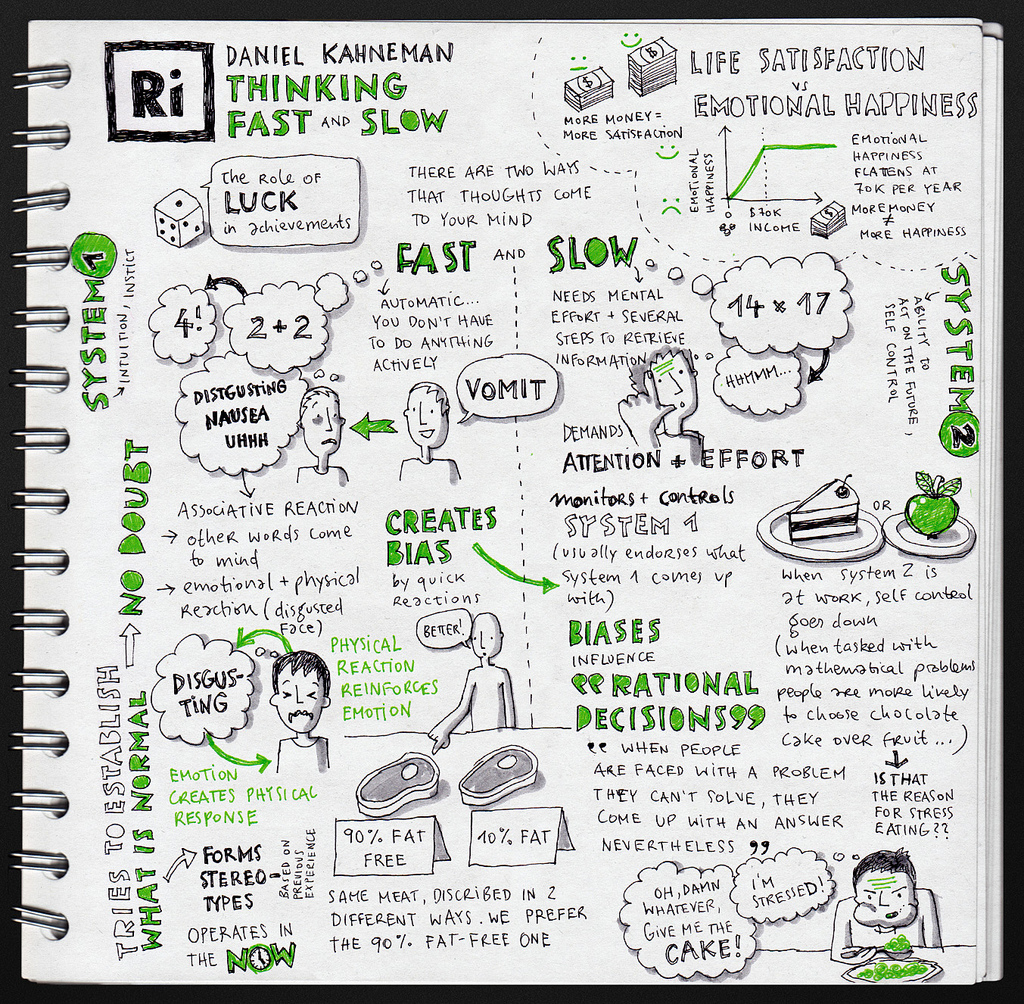
    Thinking_Fast_Slow_Summary

    First Things First – Daniel Kahneman’s “Thinking, Fast And Slow” Is A Must Must Read Book ! Yes – READ IT. It Is One Of The Best Investments You Will Make.

    Daniel Kahneman is the first non-economist to profession to win the Nobel Prize in Economics. But do not worry – the book is easy read and very though-provoking. The book aims to help us understand our systematic errors (biases) so that we an anticipate, identify and avoid them. An accurate diagnosis of our errors of judgement and choice may prevent or limit the damages of our errors.

    The central theme is that our minds have two systems for making decisions – System 1 and System 2.

    System 1 operates automatically and quickly, with little or no effort and no sense of voluntary control.
    System 2 allocates attention to the effortful mental activities that demand it, including complex computations. The operations of System 2 are often associated with the subjective experience of agency, choice, and concentration.

    The books speaks of the role and importance of System 1 in our lives and decisions – intuitions, illusions. It controls us more than we think it does. We become strangers to ourselves. Eventually, System 2 should drive us. And if System 1 is driving us, we should slow down and change course.

    The book touches upon many topics and each one is worth diving further into. I am resisting my temptation to write about all of them – as I want you to read the book.

    Let me touch upon selective interesting points:

    1. One of the important point is about Focus. Multi-tasking is not a great thing as self-control and deliberate thought apparently draw on the same limited budget of effort. Self-control requires attention and effort. Focus and maintaining a consistent thought process requires discipline. Hence tired and hungry judges tend to fall back on the easier default position of denying requests for parole rather thank think more deeper on merits of the case.

    2. High correlation exists between thinking and self-control. People with high self-control have higher measures of executive control in cognitive tasks, and especially the ability to reallocate their attention effectively. The children who had shown more self-control as four-year-olds had substantially higher scores on tests of intelligence. There is a significant difference in intellectual aptitude between people with different self-control.

    3. Another interesting finding is the idea of money primes individualism: a reluctance to be involved with others, to depend on others, or to accept demands from others.

    4. Cognitive Ease allows System 1 to be in control while Cognitive Strain determines whether System 1 should involve System 2. Hence marketing works on creative cognitive ease and lead us to intended behaviours. Using bold colors, simpler language helps. If the message is to be printed, use high-quality paper to maximize the contrast between characters and their background. If you use color, you are more likely to be believed if your text is printed in bright blue or red than in middling shades of green, yellow, or pale blue. As we all know, repetition induces cognitive ease and a comforting feeling of familiarity. It is the exposure effect. A good mood weakens System 2 and hence one needs to be extra careful. Similarly, one should not dismiss an idea because it is badly packaged in a hard language or bad font.

    5. The Wisdom of Crowds indeed makes sense. A collective judgement is often superior to individual judgements.

    6. Whenever taking decisions, ensure that the different biases are checked:
    Halo Effect
    Substitute Effect
    Anchoring
    Availability
    Optimism Bias

    A checklist is a great tool for making decisions.

    Example of Availability Bias: People feel politicians and celebrities often resort to Adultery? Does the aphrodisiac of power cause such behaviour? Statistically, politicians and celebrities have same amount of affairs as other people – it is only that their cases get highlighted more in the media and we tend to feel that they are more morally challenged.

    7. Bad News: Some experimenters have reported that an angry face “pops out” of a crowd of happy faces, but a single happy face does not stand out in an angry crowd. The brains of humans and other animals contain a mechanism that is designed to give priority to bad news. By shaving a few hundredths of a second from the time needed to detect a predator, this circuit improves the animal’s odds of living long enough to reproduce. The automatic operations of System 1 reflect this evolutionary history. No comparably rapid mechanism for recognizing good news has been detected. Of course, we and our animal cousins are quickly alerted to signs of opportunities to mate or to feed, and advertisers design billboards accordingly. Still, threats are privileged above opportunities, as they should be.

    8. The sunk-cost fallacy keeps people for too long in poor jobs, unhappy marriages, and unpromising research projects.

    9. people expect to have stronger emotional reactions (including regret) to an outcome that is produced by action than to the same outcome when it is produced by inaction

    10. The greatest test for professionals including fund managers is persistent achievement.

    Most of the buyers and sellers know that they have the same information; they exchange the stocks primarily because they have different opinions. The buyers think the price is too low and likely to rise, while the sellers think the price is high and likely to drop. The puzzle is why buyers and sellers alike think that the current price is wrong. What makes them believe they know more about what the price should be than the market does? For most of them, that belief is an illusion.

    The book contains many memorable quotes. For example:
    – Pupil of the eye is the window to the soul.
    – Emotional tail wags the rational dog

    The book is replete with rich examples and interesting anecdotes. Some examples were really amazing and though-provoking.

    1. The Equation for Success

    According to Kaheman, his favourite equation is:

    Success = Talent + Luck
    Great Success = A Little More Talent + A Lot Of Luck

    We tend to undermine the role of luck. Whether analyzing stock markets or other events, we tend to ignore the role of luck.

    2. The Formula for Marital Stability

    Frequency of Lovemaking minus frequency of quarrels

    Sounds obvious? Now this is endorsement from the Nobel-prize winning Guru!

    3. The September 11 Attacks

    If an event had actually occurred, people exaggerated the probability that they had assigned to it earlier. If the possible event had not come to pass, the participants erroneously recalled that they had always considered it unlikely.

    The worse the consequence, the greater the hindsight bias. In the case of a catastrophe, such as 9/11, we are especially ready to believe that the officials who failed to anticipate it were negligent or blind. On July 10, 2001, the Central Intelligence Agency obtained information that al-Qaeda might be planning a major attack against the United States. George Tenet, director of the CIA, brought the information not to President George W. Bush but to National Security Adviser Condoleezza Rice. When the facts later emerged, Ben Bradlee, the legendary executive editor of The Washington Post, declared, “It seems to me elementary that if you’ve got the story that’s going to dominate history you might as well go right to the president.” But on July 10, no one knew—or could have known—that this tidbit of intelligence would turn out to dominate history.

    Could better thinking have changed the course of history?

    4. Michael Lewis’s bestselling Moneyball is a story about the inefficiency of the traditional mode of prediction. Professional baseball scouts traditionally forecast the success of possible players in part by their build and look. The hero of Lewis’s book is Billy Beane, the manager of the Oakland A’s, who made the unpopular decision to overrule his scouts and to select players by the statistics of past performance. The players the A’s picked were inexpensive, because other teams had rejected them for not looking the part. The team soon achieved excellent results at low cost.

    5. The basic message of Built to Last and other similar books is that good managerial practices can be identified and that good practices will be rewarded by good results. Both messages are overstated. Because luck plays a large role, the quality of leadership and management practices cannot be inferred reliably from observations of success. And even if you had perfect foreknowledge that a CEO has brilliant vision and extraordinary competence, you still would be unable to predict how the company will perform with much better accuracy than the flip of a coin. On average, the gap in corporate profitability and stock returns between the outstanding firms and the less successful firms studied in Built to Last shrank to almost nothing in the period following the study. The average profitability of the companies identified in the famous In Search of Excellence dropped sharply as well within a short time. A study of Fortune’s “Most Admired Companies” finds that over a twenty-year period, the firms with the worst ratings went on to earn much higher stock returns than the most admired firms.

    Photo Credit:

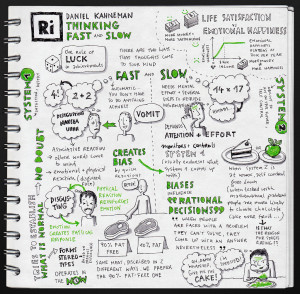
    Please Find A Very Interesting Snapshot Of The Book by: Eva-Lotta Lamm

    This sketchnote is featured in Eva-Lotta’s new book that gathers her sketchnotes from over 100 talks taken at design events and conferences in 2011.
     
    In addition, Eva-Lotta invited 10 of her favourite sketchnoters from all over the world to contribute to the book. They all sketched the same TED talk and created some stunning sketches that show off the wide variety of styles and different ways of summarising content.
     
    www.sketchnotesbook.com
  • Dream Like Ronnie !

    Dream Like Ronnie !

    The Trio of Ronnie Screwala, Zarine Mehta and Deven Khote got my attention early in life. I was in school and Doordarshan was a staple diet. United Television came across as a different company – production, content and overall packaging. The logo of UTV was stuck in mind.

    Since then UTV and Ronnie Screwvala and his team have continued to impress us. India’s first soap – Shanti was a big step at that time. It continued to grow in leaps and bound. In-flight entertainment business, post-production, IPO, broadcasting, VAS business etc. It ventured into the movie business via movie distribution and soon turned into production as well. I am sure each milestone had its share of challenges.

    Everyone sees the success and the limelight. Especially in the glamour business. Ronnie’s UTV was sold to Disney – a watershed moment for Indian entertainment industry. It was a great and a heartening story – a company that its Indian entertainment brethren and camps did not take seriously initially was bought by one of the biggest and iconic entertainment companies in the world.

    Ronnie has played an important role in India movie business. During the course of my doctoral thesis on the role of modern management in Indian Film Industry, I came across many exemplary practices of UTV. I have documented them and they are a part of my thesis.

    UTV gave special importance to movie marketing and production values and content.

    Ronnie has recently penned his journey in his book – Dream With Your Eyes Open. Trust him to do the same with his book. Indian non-fiction does not get great attention. But Ronnie is trying a lot of things here as well. Check his list to redefine this space:

    1. Great Marketing Campaign Around The Book – Unless You Are Lost In Hawaiian Vacation, Very People Will Miss The Book Launch
    2. Ranbir Kapoor Launches The Book – A Perfect Launch
    3. Testimonials From Captain Of Indian Industry & Disney
    4. Testimonial From Narendra Modi
    5. India’s First Television Ad For The Book
    6. An Active Social Media Campaign, Website

    The success of the book is important as it helps to promote the message of Entrepreneurship. He says the books is about “It can be done” and not “I did it” Great. The message of entrepreneurship need more ambassadors. Importance of failing. Importance of taking risks. Dreaming Big! May thousands of Ronnie bloom !

    Related Links:
    Book Website – Dreams With Your Eyes Open

  • Haider – Making Shakespeare Proud !

    Haider – Making Shakespeare Proud !

    Haider – A Must Watch Film

    Haider Is The Third Film In Vishal Bharadwaj’s Shakespearean Triology – A Fitting Finale !


    Haider2

    Vishal Bharadwaj Is One Of The Finest Talents In Indian Cinema. He Proves It Again With Haider. Vishal Has Wore Multiple Hats For The Film – Proving His Genius.

    Vishal Took Shakespeare To Eastern UP and Mumbai Underworld Via Omkara And Maqbool Respectively – This Time His Spotlight on Kashmir. The Kashmir Situation Provides A Perfect Backdrop To The Complex Human Relationship Drama.

    Shahid Kapoor Delivers His Best Ever Performance – Clearly Scoring Several Brownie Points And Showing His Real Talent ! Shahid’s ‘To Be Or Not To Be’ Speech Is Just One Example Of A Perfectly Optimized And Balanced Performance. ‘Chutzpah And AFSPA’ Is Another Example. Shahid’s Transformation From A Poet To A Rebel Is Very Commendable.

    Tabu Outgrows Everyone. This Is The Tabu We Have Been Missing. An Woman With Ambivalent Feelings. Watch Her Talk About She Being The Villain Always! Or Her Looks When Shahid Meets Her After Her Second Marriage. Her Fragile, Heartbreaking, Vulnerable Portrayal Is The Stellar Performance Of The Film.

    Kay Kay, Irrfan, Shraddha Kapoor Deliver Power-packed Performances In The Important Characters In The Opera. The Grave Diggers, The Two Salmans, Haider’s Father Are Equally Important Portrayals. Cinematography Is Captivating Indeed.

    The Film Could Have Done With Sharper Editing, Removal Of Forced Romantic Song.

    Shahid And Vishal Did Not Charge For The Movie – Proves That Best Things Are Priceless.

    This Is Definitely Vishal’s And Shahid’s Best Film. National Award For Vishal, Shahid And Tabu? Fingers Crossed !

  • Book Review – The Difficulty Of Being Good

    Book Review – The Difficulty Of Being Good

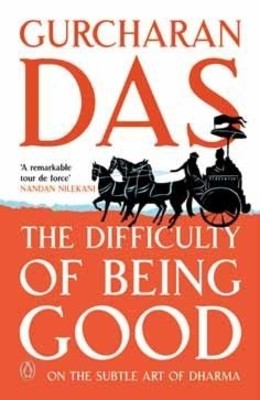
    Gurcharan Das is one of the favorite Indian writers. I loved his India Unbound and I follow his columns as well. I read his book ‘The Difficulty Of Being Good’ this week.

    ‘The Difficulty Of Being Good’ explores the subtle art of Dharma. The book revisits the story of Mahabharata and presents it from the perspective of different traits of its characters. Envy, Courage, Revenge, Dharma, Remorse etc. are explored. The author also adds recents anecdotes of Satyam, Reliance and other events to give it a contemporary linkage.

    The central theme is discussions around Dharma. Draupadi questions Yudhistir on what did he achieve after following Dharma? He got only grief and pain. She asks – Why be good? Yudhistira says – I act because I must. That is the central definition. Right Action itself is the reward.

    Mahabharat concludes that wealth and pleasure follow Dharma yet Dharma is not pursued. Dharma means praying for well-being of others. Through thoughts, actions and speech, if we can do good for others, it is Dharma.

    The common problem is that we would feel bad if we act according to Dharma and yet the other one is unjust. Or worse our opponent / rival, exploit our goodness. The response is again the same – Following Dharma itself is a reward. Of course, one should try to be smart. Mahabharata does not following Gandhian principle of offering the other cheek. (The book says that Gandhi succeeded because the opponent was Britain. British are rational and logical and workable. But it we had toxic terrorist regimes as opponents, Gandhi may not have succeeded. Who knows?)

    Dharma in everyday life is doing one’s best. Living life with compassion and equanimity is vital. One could live life like a twig of tree and respond to the currents of life water appropriately.

    The other interesting points are:
    1. Mahabharat is ‘A series of precisely stated problems imprecisely resolved’ !
    2. Time cooks us all. (Remember the opening of B R Chopra’s Mahabharat – Main Samay Hoon). Time cooks beings. Why would the war happen otherwise?
    3. Mahabharata is a story of deception. Deception happens on both side. It might have been difficult for Pandavas to emerge victorious without breaking many rules. Killing of Drona, Karna and gunning down Bhishama were not according to the war rules. Krishna would term as strategic moves.
    4. It is not easy to classify Kauravas and Pandavas as bad and good. The better word would be to state that Pandavas are the preferred side.
    5. The claim of Pandavas to throne was never a clean one due to ambiguity of lineage. Strictly speaking, King Pandu had no sons.
    6. Kauravas had deep envy of Pandvas. Author gives example of Ambani brothers. Envy kills !
    7. Disrobing of Draupadi had many questions. How could a king who has lost himself wager his wife?
    8. Action always beats inaction. Action is fruit in itself.
    9. Yudhistira cursed that women will not be able to keep the secrets – that is where it started 🙂
    He was not happy that his mother did not tell him about Karna.
    10. Yudhistira has once to choose to save only his one brother from four brothers who are dead. He choses Nakula so that each of his two mothers have only surviving son. His sense of justice is exemplary.

    I found it is as a different and interesting read. It reinforces the belief in doing our best and not worrying about results. It tells about pursuing the right path of Dharma. Krishna tells that it does not matter if you bend the rules for the righteous victory – I do not agree to this though ! The path is sometimes as important as the goal. Difficult in today’s times !

    Though I believe Bhagwad Gita is the best management book. The central theme is Action ! Read my Bhagwad Gita review.

    ‘The Difficulty Of Being Good’ is worth reading for sure !

  • Oxford Word Of The Year – SELFIE !

    Selfie Is The New Buzz In The World ! And Even Oxford Dictionary Now Acknowledges It !

    Oxford Dictionary Word Of The Year 2013 : Selfie

    Selfie is a photograph that one has taken of oneself, typically with a smartphone or webcam, and uploaded to a social media website. It could be also describe our self-absorption with the social media.

    The frequency of the word in English language has increased by 17,000 per cent since last year. There were 57 million photos with the hashtag #selfie on twitter.

    Selfie beat others words including twerk to make it to the Word Of The Year.

    High-Res-Infographic-Selfie-Oxford-Dictionaries-Word-of-the-Year-2013-2

    Oxford Word Of The Year

    How Word Of Years Is Chosen?

  • Subroto Bagchi On Re-Inventing Oneself !

    Subroto Bagchi On Re-Inventing Oneself !

    Subroto Bagchi – One of the most wonderful and humble persons you will ever meet ! I had the good fortune of meeting this amazing human being and brilliant mind today.

    Subroto is one of the highly popular and engaging authors. His books connect with us due to the sheer honesty and genuineness. I have read all his books and I am his ardent fan. Hence I grabbed the opportunity to meet him today when CII organized the round-table discussion with him. I and few other IT Professionals met him at EDI, Gandhinagar today.

    Utpal asked Subroto about the different roles described in his book. Subroto explained the different roles as under:
    1. Rainmaker – Every organization needs these people – people who can get business. Every sales person should be a rainmaker.
    2. Thought Leader – People who can see ‘Day After Tomorrow’. People who are visionaries and connect dots which do not exist !
    3. Ninjas – People who can get flawless execution done without process violation within the time and budget constraints.
    4. Coach – People who can train and mentor people.

    Every organization needs a good mix of these roles to succeed. Organizations cannot be just Ninjas alone or Rainmaker alone.

    He urged everyone of us to get a formal assessment done and understand where we stand. What is our dominant profile. And dominant profile is like our DNA – it cannot be fundamentally changed. Formal assessment will lead us to our growth – sometimes we think we are Leopards though we might be actually a Jackal !

    Subroto_Bagchi_2

    I (Ash) requested Subroto to share how we transformed himself and grew himself in MindTree’s journey from ‘Idea To IPO’. Subroto explained that he thought there were four key pillars:

    1. Humility : Humility is very essential. We need to be receptive. Actually, CEO has to be like beggar !
    2. Unusual Sources : Seek information and ideas from unusual sources. Cultivate white space time – it is very important. Important ideas do not need to happen in board rooms – they might happen in bath-tubs. And when bathtub ideas happen, do not wait for market validation or excel forecast – trust your intuition !
    3. Mental Agility : Practice mental agility. Mind needs to be agile and challenge itself. Sometimes mental agility happens with displacement – change of city etc.
    4. Sense of Purpose : The most important factor ! The purpose determines your power in life. The practical examples of Intel, Microsoft and Dalai Lama drove home this point effectively.

    Very beautiful insights – worth internalizing in life !

    Subroto also explained that entrepreneurs need to create more leaders – leaders who can see the big picture and who can have critical questioning ability. Entrepreneurs fail when they always surround people who think like them and are sycophants.

    Subroto recommended the following resources:
    1. Book: A Whole New Mind – Why Right-brainers Will Rule the Future is a book by Daniel H. Pink
    2. Movie Documentary : Infinite Vision
    3. Book: Leading with Questions – How Leaders Find the Right Solutions By Knowing What To Ask

    Apart from the amazing experience, my reward was to get his personally autographed book ! Happy !!!

  • Dance Your Ph.D Contest 2013

    Academics can be monotonous. But if you are capable of adding some imagination and fun to it, it can prove quite rewarding. The Dance Your Ph.D. contest 2013 is one such attempt of artistic expression of your academic work.

    Organised by international journal, Science, the competition is held every year in which thousand of students pursuing their Ph.D. translate their thesis in interpretive dance forms. The competition is open for students who have completed their Ph.D. even if it happens to be 50 years ago.

    Open for science faculty student, the candidate doing the Ph.D. is the main protagonist who explains his/her thesis work either in solo, duet or group dance form and has to be posted at Vimeo.com. The subjects covered in the category are Physics, Chemistry, Biology and Social Sciences category.

    The Ph.D. in each subject carries a cash prize of $500. The best work will be further awarded with additional $500, thus making it to $1000.

    The last day to submit the entry is October 1, 2013.

    How To Enter:

    Turn your Ph.D. thesis into a dance.
    Post the video at Vimeo.com.
    Send the link by October 1, 2013 to the organiser.

    The Prizes:

    Physics – $500
    Chemistry – $500
    Biology – $500
    Social Sciences – $500

    Best Ph.D. Dance of 2013

    An additional $500

    The Rules:

    1. You must have a Ph.D., or be working on one as a Ph.D. student.
    2. Your Ph.D. must be in a science-related field.
    3. You must be part of the dance.

    Source : India Today

  • The Increasing Tribe Of Graphical Novels !

    The Increasing Tribe Of Graphical Novels !

    As The Attention Deficit Increases, The Need For Innovative Marketing Medium Increases. How Do We Engage The Audience Better Is A Key Question? How Do We Ensure Stickiness?

    The World Is Moving Towards Video And Images. An Important Trend Has Been Graphical Novel !

    Many People Think Graphical Novel Is For Kids. But It Is Finding Increasing Acceptance Across The Board. All Of Us Still Have A Kid In Us. I Still Love My TinTin Comics As Well As Chacha Choudhary Comics. Chandmama Was A Staple Diet.


    The Zen Of Steve Jobs Was A First Big Hit For Graphical Novel Movement. Today, It Is A Very Popular Medium. Even Bollywood Movies Have Graphical Novels. Gandhiji’s Auto-Biography Will Be Released In Graphical Novel Form.

    I Came Across This In Mint – Produced By Manta Ray. Check Out The Theme Of Our Genius !

    free digital copy