A city’s mobile industry had no room of its own — so we built one, ran it for nearly a decade, and when it had done its job, closed it with gratitude and a note that said: our work here is done.
Snapshot
- Co-founded with Rajnikant Joshi and Gargi Das as the 107th chapter of the global Mobile Monday network
- Launched December 2010 at CIIE, IIM Ahmedabad, with support from Infostretch and BlackBerry
- Monthly evening sessions and Saturday technical workshops, free and open to all
- Thousands of engineers, founders, and students through the door across nearly a decade
- Annual hackathon co-organised with Azoi; topics tracking the industry from apps to AI
- Helped an entire generation of Ahmedabad IT companies build their mobile practices
- Sunset in January 2019 — original purpose served, exit made with intention
- Global network: 100+ cities, 50+ countries; MoMo founded in Helsinki in 2000
Mobile Monday Ahmedabad
The mobile-industry community we founded in 2010 — and the discipline of knowing when a thing has done its job.
In the autumn of 2010, mobile was no longer a niche. The iPhone was three years old. BlackBerry was at the height of its enterprise reign. Android was still finding its feet. Across India, hundreds of small companies were beginning to build apps, port games, and sell mobile services to clients across the world. Ahmedabad — historically a textiles and pharmaceuticals town with a growing technology shoulder — was quietly becoming part of this story.
What it did not yet have was a place for the people inside it to meet each other.
Most cities the size of Ahmedabad had two kinds of mobile communities. The big metros — Bangalore, Mumbai, Delhi — had local chapters of Mobile Monday, the global mobile-industry network that had started in Helsinki in the autumn of 2000 when a Finnish mobile visionary named Vesa-Matti Paananen invited fifty mobile innovators to an Irish pub on a Monday evening. The smaller cities had nothing. Developers worked in isolation, in basement offices, on contracts they had won online, with no one nearby to compare notes with.
I had been watching this for two years. By late 2010, I was at the head of business strategy at Infostretch (later Apexon), itself a mobile-first company headquartered in Ahmedabad. We needed talent. We needed peers. We needed a room.
So Rajnikant Joshi, Gargi Das, and I built one.
Rajnikant was a software professional whose expertise lay in mobile development for Android and BlackBerry — at a time when both platforms were the future. Gargi was a Forum Nokia Champion, an electronics and communications engineering graduate with deep expertise in Symbian and iOS, and one of the genuine technical authorities on mobile in the city. I brought the business-strategy and ecosystem side from Infostretch. The three of us, between us, covered enough of the mobile stack that the chapter would have something useful to say from day one.
The launch — December 2010
Mobile Monday Ahmedabad launched as the 107th chapter of the global Mobile Monday network. The inaugural event drew 102 mobile enthusiasts — engineers, founders, students, OEM representatives, telecom executives — into a room at the Centre for Innovation, Incubation and Entrepreneurship (CIIE) at the Indian Institute of Management, Ahmedabad, our academic host and venue partner.
The topic of the inaugural evening was “Mobile Ecosystem & Trends in Gujarat.”
Our chief guest was Shri Ravi Saxena, Chief Additional Secretary to the Government of Gujarat. Our first speaker — flown in specifically — was Mr Kesava Reddy, Founder of MoMo Bangalore, who had been running his chapter for three years and brought us the hard-earned playbook of running a city-level mobile community in India. Devang Nanavati, Jay Ruparel, Madhu Mehta, and Anand Virani filled out the panel.
Our advisory was Shri Umesh Shah and Shri Milan Patel. CIIE was led for our purposes by Shri Pranay Gupta, Prof. Jajoo, and Prof. Rakesh Basant. Our launch sponsors were Infostretch — represented by Rutesh Shah and Vipul Jani — and BlackBerry, represented by Annie Matthew. The core volunteer team — Ankit Mehta, Pranay, and a dedicated group including Rupal, Jaspal, Bhavika, Chinar, Gifty, Kalpana, and Rohit — carried the operations alongside the three of us.
The chapter did, in one room on one Monday evening, what a city had not previously done: bring its mobile industry into the same conversation.
The next event was scheduled for the first Monday of January 2011. The format — monthly Monday evening sessions, with occasional Saturday technical workshops, all events free and open to anyone — was set.
What we did
For nearly a decade, Mobile Monday Ahmedabad ran without missing many months.
Every first Monday, we gathered. Sometimes thirty people. Sometimes two hundred. The topics moved with the industry — Mobile Ecosystem & Trends in Gujarat in 2010 became HTML5 vs Native Apps by 2012, Wearables and the Internet of Things by 2014, Mobile Payments and UPI by 2017, AI on the Edge by 2018. Each evening had a speaker, a panel, a question-and-answer, and a long networking break with chai and samosas — the universal infrastructure of Indian community organising.
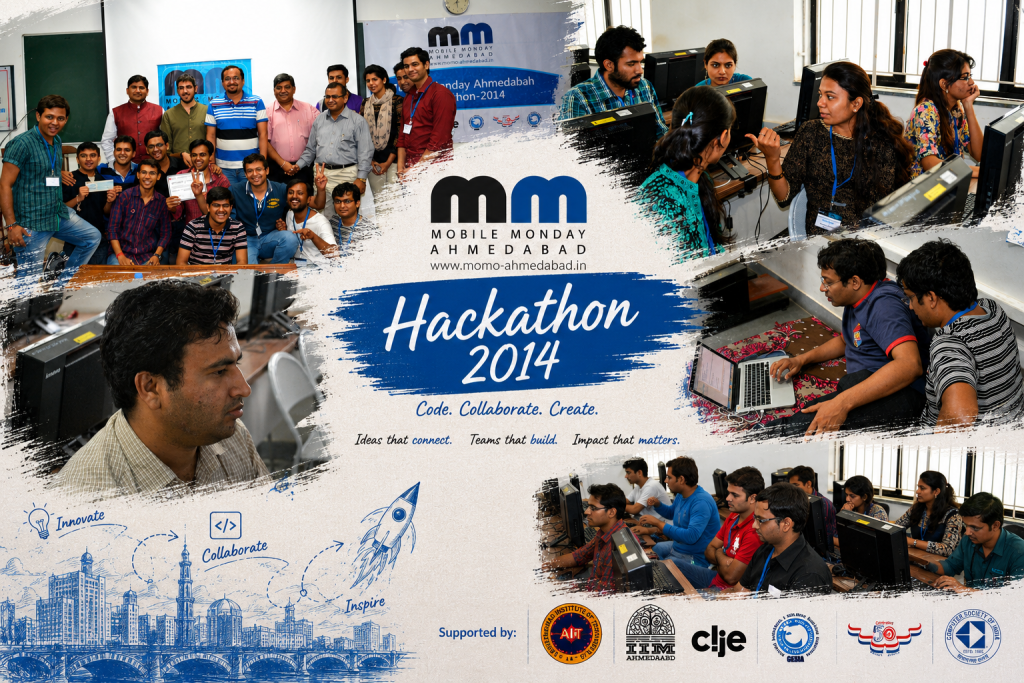
We ran technical workshops on Saturdays, when developers could actually attend. We hosted visiting speakers from Bangalore, Mumbai, and occasionally Helsinki. We co-organised Hackathon 2012 with Azoi — a thirty-six-hour event on the last weekend of March 2012, where teams built mobile applications around themes set by the sponsors. We launched our own domain, momo-ahmedabad.in, and over the years grew a community across Facebook, LinkedIn, and the city’s WhatsApp groups long before WhatsApp groups were a serious organising tool.
We were free. We were monthly. We were honest. We did not sell anything at the events.
What actually happened — the ecosystem we built
The monthly meetups were the visible surface of the work. The visible surface was the small part.
Across nearly a decade, thousands of engineers, founders, students, and curious professionals walked through the room. Some came once. Some came every month for years. We did not run a programme in the formal sense — there was no curriculum, no certificates, no fees, no enrolment — but the cumulative effect of running an open monthly forum, with serious speakers and a working culture of peer-learning, was that we trained an entire generation of Ahmedabad’s mobile workforce. By proximity. By accident. By repetition.
The harder thing to measure is what happened to the companies in the room.
When we launched in 2010, very few Ahmedabad firms had serious mobile capabilities. Most were web-services shops, BPO operations, or back-office contractors. Mobile was — for almost all of them — a thing they did not yet do.
By 2018, that picture had completely changed. Several of today’s large IT companies in Ahmedabad — names that now employ thousands of people each — built their mobile practices in those early years of the chapter. Some came in as small studios and grew through the contacts they made. Some pivoted from web to mobile-first because of what they saw at our events. Some hired their first mobile engineers from the people they met in our room. The chapter was not the only reason — Ahmedabad’s mobile growth had a hundred causes — but it was one of the conditions that made the growth possible.
I do not claim that Mobile Monday Ahmedabad built Ahmedabad’s mobile industry. I do claim that we built the room in which the industry happened to find itself. The room mattered. The room is what we did.
This is the part of the chapter’s work I am most proud of, and it is also the part nobody outside the community ever saw. The monthly meetups were a small public ritual. The ecosystem they incubated was the actual work.
On knowing when to stop
In January 2019, we wrote what was, in effect, our farewell note.
Mobile Monday Ahmedabad was launched with an aim to promote mobile technology, provide networking opportunities, address growth challenges, and groom the talent for the industry. Over the last decade, the mobile industry has grown manifold in Ahmedabad. The mobile industry itself has evolved into a larger digital economy.
Mobile Monday Ahmedabad’s original purpose has been served. Often organisations and people overstay — many times without adding any value or serving the ecosystem. Some redefine their goals and vision. Today, many other organisations serve the purpose of promoting IT and digital in the local community, and we will continue to collaborate and promote them for the larger good of Ahmedabad’s digital ecosystem.
I am quietly proud of that note. It is one of the harder things to write — the graceful exit of a community organisation whose work is done.
Most communities I have watched in India do not get this part right. They become institutions for the sake of being institutions. They convert themselves into trade bodies, consulting firms, sponsored programmes. They survive long past their original purpose, often becoming the thing they were supposed to make obsolete.
Mobile Monday Ahmedabad was built to create the conditions for an industry, not to be an industry. When the conditions were created — when developers had peers, when companies had mobile practices, when the city had its digital identity — the work was done.
I have always believed that some organisations should die well. Mobile Monday Ahmedabad did.
What it taught me
Three lessons from the decade.
Communities are the cheapest possible infrastructure for an industry. We spent nothing. We charged nothing. We built nothing more elaborate than a regular monthly evening with chairs, a speaker, and a long break for chai. That alone, repeated for years, helped a city build a mobile industry. The cost-to-impact ratio of a well-run community is staggering. Every city should have ten.
Volunteers are the only sustainable engine. Mobile Monday Ahmedabad never had paid staff. The events were organised by people who had day jobs. The speakers came for free. The venue was donated by CIIE. The food was sponsored. This is the only model that scales for a community organisation — the moment you start paying for the work, you have started running a company, and the soul of the thing changes.
The graceful exit is the hardest skill of all. Founders of communities almost always struggle to let go. The community feels like the founder’s identity; closing it feels like closing a part of oneself. The discipline of writing the January 2019 sunset note — our original purpose has been served — was the most useful thing I had to learn in the entire decade. I have since applied it to other parts of my work.
My role and theirs
Mobile Monday Ahmedabad was founded in December 2010 by Rajnikant Joshi, Gargi Das, and me, in partnership with CIIE at IIM Ahmedabad as our academic and venue host, BlackBerry and Infostretch as launch sponsors, and a dedicated team of volunteers across the years.
If you are starting a city-level industry community — or thinking about how to wind one down well — I would be glad to share what I have learned. Write to me at ash@ashokkarania.com.
— Ash