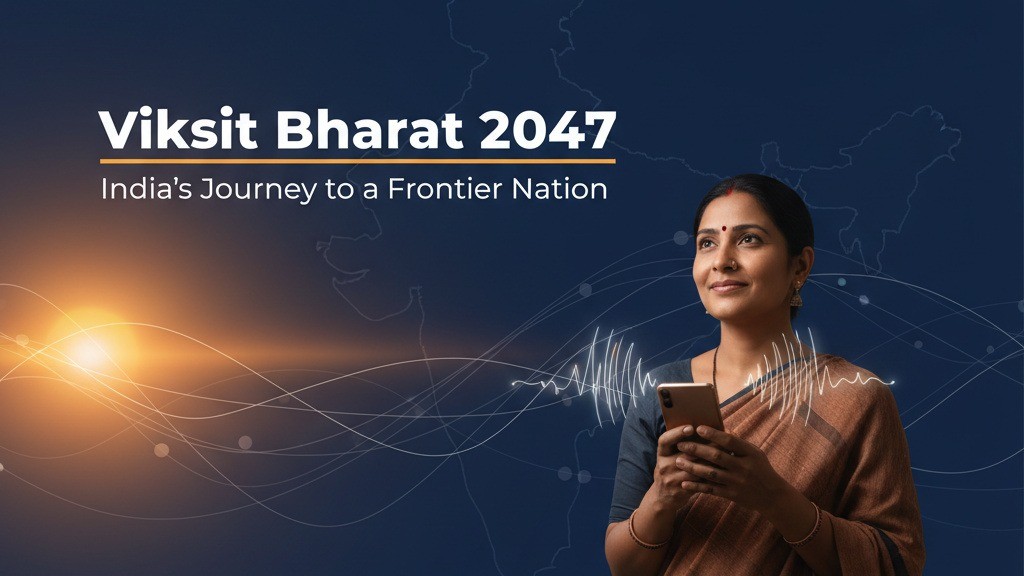
India is witnessing an unprecedented surge in AI investments. Billions of dollars are flowing into data centers, models, platforms, and startups. Global leaders are calling this India’s AI moment.
But during my recent session on AI for Inclusion and Governance, one question stood above all others:
How do we ensure India’s AI future works not just for markets — but for every Indian?
A Purpose-Driven AI Vision for Viksit Bharat
India’s aspiration to become a Viksit Bharat by 2047 cannot be measured only by GDP or global rankings. It must be measured by citizen health, opportunity, dignity, and the ability of every Indian to achieve their full potential.
AI, if designed and governed well, can be one of the strongest enablers of this vision. But inclusion will not happen by default. It must be intentional, ethical, and measurable.
Inclusion Begins with Language and Voice
One fact defines India’s AI challenge:
- 85% of Indians are non-English speaking
- India has 22 official languages and nearly 20,000 dialects
If AI remains English-first and text-heavy, it will exclude before it empowers.
That’s why India must prioritize voice-based, multilingual AI — systems that work on basic smartphones and understand how Indians speak, not just how they type.
Early examples of voice-based agents in education, healthcare, and citizen services already show how powerful this can be for first-time digital users.
For India, voice is not a feature. It is the interface.
Gender Inclusion: Making the Invisible Visible
In India, inclusion and gender are inseparable.
Women power frontline systems — teachers, nurses, ASHAs, anganwadi workers — and form the backbone of SHGs and informal enterprises. Yet they are often excluded from digital and financial systems.
One stark example: Women entrepreneurs are frequently rejected twice for credit — once by informal systems, and again by formal ones — not because they are risky, but because they are invisible to traditional credit models.
This is where AI can become a force for inclusion.
By analysing UPI transaction patterns, ONDC order histories, savings discipline, and cash-flow consistency, AI can build fair, behaviour-based credit scores that reflect real economic activity — even when formal credit history is absent.
An equally great idea is “AI Saheli” — a trusted, vernacular AI companion that helps women navigate finance, health, entitlements, and entrepreneurship.
If rural women can confidently engage with AI, India’s inclusion challenge fundamentally shifts.
Innovation for India: MSMEs, DPI, and Ecosystem Collaboration
India’s growth engine lies not only in large enterprises, but in 63 million MSMEs, most of them informal.
AI can empower MSMEs by:
- Automating bookkeeping and compliance
- Enabling market access via ONDC
- Providing multilingual copilots for pricing, sales, and customer engagement
Crucially, India does not need to reinvent infrastructure.
We already have world-class Digital Public Infrastructure:
- Aadhaar for identity
- UPI for payments
- ONDC for commerce
AI layered on top of these rails can democratize sophisticated capabilities for even the smallest businesses.
This is also where global technology platforms like Microsoft and Google play an important — but enabling — role. Not as owners of India’s AI future, but as ecosystem partners providing foundational models, secure compute, safety tooling, and skilling — while Indian startups, academia, and public institutions build context-rich, last-mile solutions.
India’s AI future must be built in India — enabled by global platforms, governed by public institutions, and guided by public purpose.
Healthcare: The Highest-Impact Frontier
India faces some of the world’s largest burdens of diabetes, heart disease, obesity, and late-stage diagnosis.
AI offers a chance to leapfrog:
- Early screening and diagnostics
- Clinical decision support
- Drug and vaccine discovery
- Population health analytics
When combined with PHCs, Ayushman Bharat, and ABDM, AI can shift India from reactive care to predictive and preventive healthcare at scale.
This is where AI for Good becomes AI that saves lives.
Mistakes India Must Avoid
Two risks demand constant vigilance:
- AI as surveillance, not empowerment Trust is foundational. AI must strengthen democracy, not undermine it.
- AI that represents only a narrow slice of India Models must be diverse, decisions explainable, and systems auditable — especially in welfare and governance.
AI should assist judgment, not replace accountability.
The Frontier Nation Vision: Every Indian with a Co-Pilot
The future to aim for is simple:
A woman in rural India confidently speaking to an AI assistant in her language. A farmer receiving climate and crop advice by voice. An MSME owner running a business with an AI copilot. A nurse or teacher supported — not burdened — by AI.
Every Indian with a trusted co-pilot.
That is what Viksit Bharat 2047 as a Frontier Nation truly means.
Closing Thought
India has built world-class digital rails. Now we must ensure the AI running on them is inclusive by design, governed with care, and aligned with national purpose.
Because India’s AI success will not be measured by the size of our models — but by the lives we uplift.
AI for Good. AI for Inclusion. AI for India. 🇮🇳
(The above is the executive summary of my session at Indian Institute of Management Ahmedabad on “AI for Inclusion and Governance” at the Accelerating India’s Development Conference – organised by IIMA Endowment Fund).
#ViksitBharat2047 #AIForIndia #AIForGood #InclusiveAI #FrontierNation #DigitalPublicInfrastructure #AIAndGovernance
Leave a Reply