Author: afnan_bukhari

  • The Sheep Detectives: Herd-Breaking. Charming. Heartwarming. 

    The Sheep Detectives: Herd-Breaking. Charming. Heartwarming. 

    The Sheep Detectives: Herd-Breaking. Charming. Heartwarming. 

    Can a murder mystery be delightful, beautiful, and warm like a hug?

    The Sheep Detectives proves that it can.

    One of the finest family films I’ve watched this year, it blends mystery, humour, empathy and quiet wisdom into something truly special.

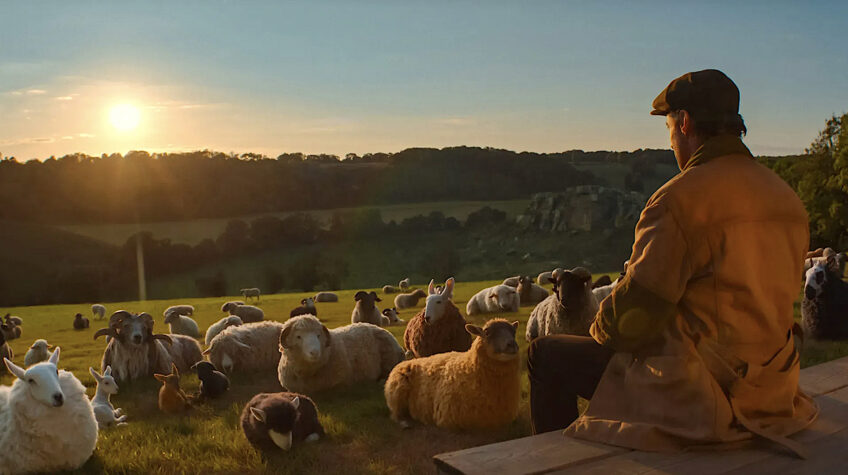
    Hugh Jackman is wonderful as George, a gentle shepherd living on a picture-perfect English farm with his beloved flock. Every sheep has a name, a personality, and every night George reads them murder mysteries—never imagining they understand every word.

    When George is mysteriously killed, the sheep decide to do what any devoted readers of detective fiction would do—they become detectives themselves.

    What could have been a quirky comedy turns into something much deeper. Beneath the laughs lies a moving story about grief, love, memory and learning to let go. The film never talks down to children, yet gives adults plenty to reflect upon as well.

    I especially loved how every sheep feels like a real character rather than comic relief. Lily’s quiet intelligence, Mopple’s innocence, Sebastian’s complexity—and George’s enduring presence—make the emotional journey surprisingly rich.

    It’s rare to find a film that is equally clever, funny and deeply human.

    A perfect family watch. One that will make you smile, laugh, and perhaps leave with a small lump in your throat.

    #TheSheepDetectives #MurderMystery #Cinema #WeekendWatch #AmazonPrime  #Storytelling #CinemaLovers #FeelGoodCinema #WeekendWatch #FilmRecommendation #SunshineLife  #FamilyCinema

  • Beyond AI: The Next Gates of Power That Will Shape Humanity

    Beyond AI: The Next Gates of Power That Will Shape Humanity

    What comes after intelligence may redefine what it means to be human.

    In my previous note, I explored the 7 Gates of Power — from land to intelligence. The deep thinker Rutesh Shah asked: What comes after the Intelligence Gate?

    Great question. If history teaches us anything, it is this: We rarely recognize the next gate while we are inside the current one.

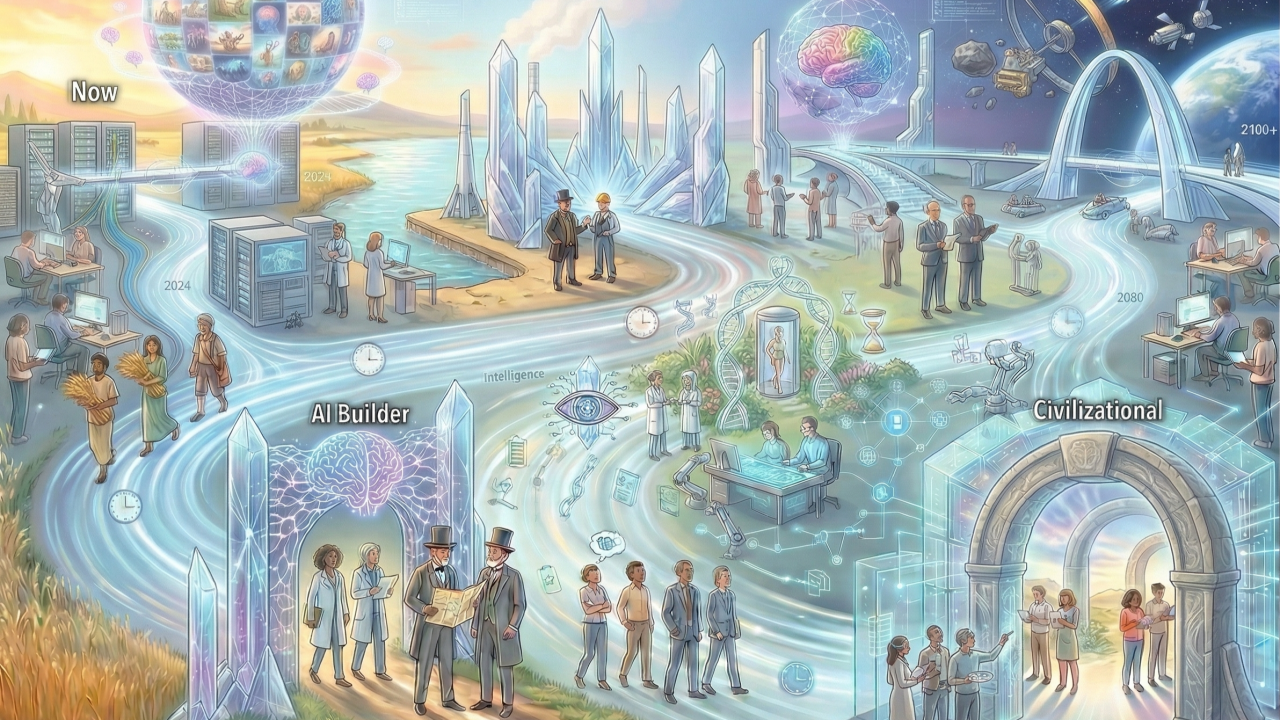
    The next gate won’t “arrive” the way previous ones did. It will emerge gradually on top of the Intelligence Gate. For now, intelligence is still becoming infrastructure. The next gate will likely be built on top of it — not instead of it.

    The Near Gates — Already Forming

    Before we look too far ahead, pause. Some gates are not in the future. They are already under construction.

    1. Compute and Energy

    This is the substrate of intelligence. Chips. Data centers. Power grids.

    Whoever controls this layer controls everything built on top of it.

    Compute and energy are already reshaping geopolitics.

    2. Biology and Longevity

    Gene editing. Synthetic biology. Ageing science.

    But the deeper shift is this: Time itself is becoming a gate.

    Those who can extend it will compound advantage in ways never seen before.

    3. Trust and Identity

    In a world of agents and synthetic media, the hardest problem won’t be intelligence.

    It will be verification. Knowing what is real. Knowing who is real.

    Trust infrastructure is the most underestimated gate forming today.

    The Gates We Can Barely Name Yet

    Beyond these, the next gates move inward — toward the human experience itself.

    4. The Consciousness Gate

    Not just intelligence — but experience itself. If we can map, store, or transfer consciousness, the gate shifts from information to awareness. Whoever controls this layer controls something more intimate than data ever was.

    5. The Reality Gate

    We are moving from observing the world to mediating it. As AI and spatial computing evolve, reality becomes programmable. The gate becomes: who controls perception itself.

    6. Meaning

    When AI handles creation, decisions, and productivity, something else becomes scarce: purpose. belonging. identity.

    Whoever shapes meaning frameworks may hold a more enduring gate than any technology.

    7. The Longevity Gate

    This is not just about health — it is about time as leverage. If lifespan becomes engineerable, compounding itself becomes unequal. The gate shifts from wealth to who gets more time to build it.

    8. The Synthetic Labor Gate

    For the first time, labor can scale without humans. Humanoids and autonomous agents will not assist work — they will be the workforce. Control over this layer is control over the new means of production.

    9. The Planetary Gate

    We are approaching the ability to influence climate and ecosystems at scale. Geo-engineering turns nature into something that can be shaped. The gate becomes: who can alter the conditions of the planet itself.

    10. The Protocols Gate

    In a world of autonomous systems, power shifts to who writes the rules. Protocols will define how intelligence interacts, verifies, and governs itself. This is control not of systems — but of the laws they operate by.

    The Deeper Pattern

    Every previous gate controlled something outside us. Land. Energy. Data.

    The next wave moves inward.

    Towards: • consciousness • perception • meaning • identity

    A Final Thought

    History was shaped by those who controlled the world. The future may be shaped by those who control how the world is experienced — and understood.

    Because the ultimate gate may not be technological at all.

    It may be: Who defines reality. Who shapes meaning. Who decides what it means to be human — in a world where intelligence is no longer uniquely ours.

    What do you think are the next gates?

    #ArtificialIntelligence #AgenticAI #FutureOfHumanity #Leadership #Innovation #TechnologyStrategy #FutureOfWork #Gates #FutureTrends #TrendSpotting

  • Life Beyond Agents

    Life Beyond Agents

    Agents are the opening move. The Autonomous Enterprise is the game. Here is what separates the leaders who understand that from the ones who don’t.

    Assume agents work.

    Assume your organization has deployed them across claims processing, clinical documentation, contract review, and underwriting. They are running reliably, governed properly, delivering measurable ROI.

    Now what?

    That question — almost never asked — is where real strategic divergence begins. The organizations thinking seriously about it are already operating in a different category from the ones still focused on deployment.

    This article is for leaders in that first category. Or the ones who want to be.


    The number that reframes everything

    Capgemini projects AI agents will generate $450 billion in economic value by 2028. At that scale, agents are not a feature or a department initiative. They are an operating layer — a parallel workforce that needs to be led, governed, measured, and developed with the same intentionality you bring to your human organization.

    McKinsey finds only 1% of organizations have achieved true AI maturity. The other 99% are still asking how to build and deploy agents. The 1% have moved to a fundamentally different question:

    How do we operate as an Autonomous Enterprise?

    Not a company that uses AI. A company that runs on it — where humans set strategy, define values, and establish boundaries, and intelligent digital workforces handle execution at a scale no human organization could match alone.

    That is the destination. These are the five shifts that determine who gets there.


    Five shifts that separate leaders from followers

    1. Your most valuable asset is no longer your data. It is your domain intelligence.

    The race to build the largest AI model is over. The next competition runs in the opposite direction — toward precision.

    Domain-specific Small Language Models trained on clinical literature, regulatory filings, and proprietary transaction data are outperforming general-purpose giants in bounded, high-stakes tasks. They are faster, cheaper, and critically, more defensible in front of a regulator. Healthcare systems face increasing pressure to explain clinical AI recommendations. Insurance commissioners are mandating that underwriting decisions be traceable. A model trained on the entire internet cannot satisfy that requirement. A model trained on twenty years of your own claims decisions, calibrated to your patient population, governed against your clinical protocols — can.

    The organizations building domain intelligence strategies today will hold assets in three years that competitors cannot quickly replicate.

    The executive question: Is your organization treating its domain data as a strategic asset for building proprietary intelligence — or simply as input to someone else’s model?


    2. The operating model of the future runs on digital twins, not dashboards.

    Dashboards tell you what happened. Digital twins tell you what will happen — and let you intervene before it does.

    The convergence of real-time IoT data, AI simulation, and cloud infrastructure has made operational twins viable far beyond their original engineering applications. A hospital operations twin that models patient flow and staffing 48 hours ahead. An insurance risk portfolio twin that simulates catastrophe scenarios and reprices exposure before losses materialize. A pharmaceutical supply chain twin that reroutes production before a disruption reaches the manufacturing floor.

    IDC projects the digital twins market reaches $110 billion by 2028. But the market size is the least interesting part. Organizations with operational twins are not just making better decisions. They are making decisions at a speed and precision that organizations without them structurally cannot match — regardless of how many agents the latter have deployed.

    The executive question: Where in your operations would a real-time simulation model create a structural advantage your competitors cannot easily replicate?

    Recommended by LinkedIn

    Overnight, humanity stands at the precipice of an AI…

    Gareth Stokes  1 year ago

    When Policy Races Ahead: Closing the Gap Between AI…

    KUMA  4 months ago

    Can Agentic AI Help My Business, and How Will it…

    Kartik Patel  4 months ago


    3. The workforce redesign crisis is arriving faster than anyone is preparing for.

    McKinsey estimates AI agents will absorb 20 to 40% of current enterprise workflows by 2030. The technology exists today. The organizational infrastructure to manage the transition does not.

    When a health system has 30 human nurses and 200 AI agents coordinating patient care, who is accountable for what? When a claims department processes 80% of routine cases automatically, what does an experienced adjuster do — and how do you retain the institutional knowledge that makes their judgment irreplaceable on the 20% that require it? These are not technology questions. They are organizational design questions. And the striking thing about the current enterprise AI conversation is how rarely they surface.

    Capgemini finds 38% of organizations expect AI agents as team members within human teams by 2028. The organizations designing that future now — rethinking roles, management structures, and decision rights for human-agent teams — will be dramatically better prepared than the ones who encounter it as an operational surprise.

    The executive question: Have you started designing the organization your enterprise will need in three years — or only the technology?


    4. The commercial model is changing. Most buyers haven’t noticed.

    When an agent processes 10,000 prior authorization requests overnight, billing for “hours of prior auth work” is indefensible. When a contract review agent analyzes 500 agreements in the time a human reviews five, the cost-per-contract collapses. Effort-based commercial models are structurally incompatible with what agents can do.

    HfS Research calls the emerging alternative Services-as-Software — charging per authorization processed, per claim adjudicated, per insight generated. Bloomberg estimates outcome-based contracts will grow from 10% to 60% of enterprise agreements within a decade.

    The vendors who cannot shift to outcome-based pricing are implicitly telling you they are not confident enough in their results to be measured by them.

    The executive question: Are your most important technology partnerships structured around outcomes or effort? The answer tells you which vendors are ready for the next era — and which are not.


    5. Governance is not a constraint on AI ambition. It is the condition for it.

    Gartner predicts more than 2,000 “death by AI” legal claims by end of 2026. Trust in autonomous AI has fallen from 43% to 27% in a single year (Capgemini). The EU AI Act is in force. US state regulators are advancing model laws on insurance and healthcare AI.

    The organizations that scale most successfully will not be the boldest. They will be the best governed — with explainability engines, meaningful human-in-the-loop controls, and board-level AI risk visibility that matches the quality of oversight directors already apply to financial exposure.

    Every organization that has tried to scale AI without governance has hit a ceiling. Every organization that built it in from the start found the ceiling disappear — because sound governance converts skeptical board members, cautious regulators, and nervous legal teams from blockers into supporters.

    The executive question: Does your board have the same quality of visibility into your AI risk exposure as it has into your financial risk exposure? If not, that gap is your highest-leverage governance investment.


    What this requires of leaders

    The Autonomous Enterprise is not a technology project. It is a leadership challenge.

    It requires holding two time horizons simultaneously — executing on agentic AI deployments that create value today, while building the organizational, commercial, and governance infrastructure that determines who leads tomorrow. The five shifts described here are not sequential. They are concurrent. Organizations that treat them as a single integrated agenda will compound advantages across all five at once. The ones that address them separately, when each becomes urgent, will find themselves perpetually a cycle behind.

    Agents are a profound capability. They are not the destination.

    The Autonomous Enterprise is — and the leaders building toward it now are already playing a different game.


    What shift are you most focused on — or most concerned about? I read every comment.

    #AutonomousEnterprise #AgenticAI #AIStrategy #FutureOfWork #EnterpriseAI #DigitalTwins #CXO #AIGovernance #Innovation #DigitalTransformation

    TechTonicTechTonic

  • The Transformation We Keep Postponing

    The Transformation We Keep Postponing

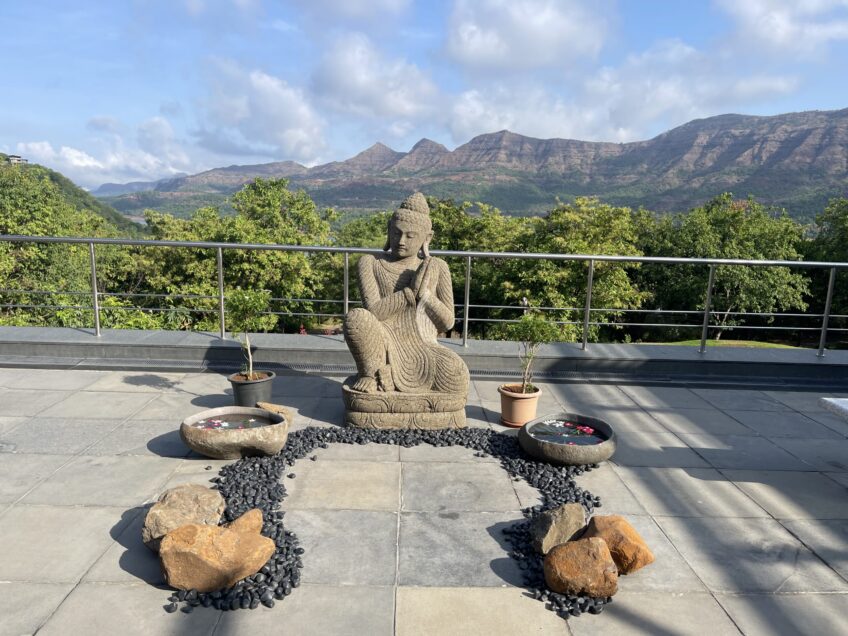
    A few weeks ago, I spent seven days at a wellness retreat in the Sahyadris.

    There were doctors, therapists, yoga sessions, meditation halls, organic farms, barefoot walks, and enough healthy food to make a lifelong ginger chai enthusiast voluntarily stop drinking tea for eight days.

    Yet the most important lesson had very little to do with wellness.

    It began with an uncomfortable observation.


    Most of us are constantly improving something.

    We improve our careers. Our homes. Our teams. Our businesses. Our productivity systems. Our children’s futures.

    Improvement has become a way of life.

    And yet, somewhere in the middle of all this progress, we quietly stop improving the one person experiencing it all.

    Ourselves.

    Not our resumes. Not our skills. Not our balance sheets.

    Us. The human being beneath the professional identity. The person beneath the title. The soul beneath the schedule.


    During the retreat, the days followed a simple rhythm.

    Wake early. Walk. Breathe. Eat mindfully. Move. Rest. Sleep.

    Nothing revolutionary. Nothing expensive. Nothing particularly difficult.

    And yet, by the fourth day, something surprising happened.

    The body began to cooperate. The mind became quieter. The constant internal urgency softened.

    I realised how much of modern life is lived slightly out of rhythm.

    We sleep later than our bodies prefer. We eat faster than our digestion appreciates. We consume more information than our minds can process. We spend more time connected than we do present.

    And then we wonder why we feel tired.


    There was another realisation that stayed with me.

    Many of the practices that produced the biggest shifts were astonishingly simple.

    Morning sunlight. Walking barefoot on the earth. Eating earlier. Breathing more consciously. Sleeping on time. Spending less time with screens.

    None of these would qualify as innovation. Most would not attract venture capital.

    Yet they worked.

    Perhaps one of the great mistakes of modern life is assuming that every meaningful solution must be complex. We have become brilliant at building sophisticated external systems. The body, however, still runs on ancient code.

    It responds to rhythm. To light. To movement. To rest. To attention.

    The body is not asking for heroics. It is asking for cooperation.


    Three ideas emerged from that week. They have not left me since.

    Rhythm over resolution. True alignment is not aggressive discipline — it is a design philosophy. Sleeping at 10 and rising at 5 is a complete sentence. The body already knows its optimal baseline. Our only job is to stop arguing with it. Consistency does not demand heroics. It simply builds the biological scaffolding that everything else hangs from.

    Food as mindful medicine. We routinely surrender our physical fuel to processed shortcuts. Simple, whole ingredients, eaten at the right hour, possess an immediate pharmacological power that most of us have never tested because we have never truly tried. Transformation does not require deprivation. It requires structural intelligence. The most surprising lesson of the week was not what I ate. It was what I stopped consuming. Tea. Sugar. Noise. Urgency.

    Restoring the holy trinity. As a culture, we are masterful at sharpening the intellect. More recently, we have begun paying attention to the body. But the soul — that quiet, luminous inner dimension — is often treated as a background process, served last, if at all. No popular metric tracks it. No dashboard measures it. No wearable device can tell us when it is thriving. Yet its neglect is quietly felt everywhere. True equilibrium requires treating mind, body, and soul not as separate silos but as one deeply interconnected ecosystem.


    The great paradox of modern life may be this.

    We have never been better at transforming everything around us.

    And we have never found it harder to transform what is within us.

    Progress has given us many gifts. But it has also created a peculiar illusion: that transformation is something external. A better role. A better city. A better device. A better future.

    Yet some of the most meaningful transformations begin when nothing external changes at all.

    When we sleep a little earlier. When we pay attention to what we eat. When we sit quietly for ten minutes. When we take a walk without headphones. When we listen — not to the world, but to ourselves.


    And perhaps that is why this feels increasingly important in the age of AI.

    As machines become better at processing information, generating content, and automating work, the distinctly human dimensions of life become more valuable, not less.

    Presence. Awareness. Stillness. Meaning. Compassion. Connection.

    No machine can meditate on your behalf. No algorithm can walk barefoot on the earth for you. No agent can cultivate your inner life.

    The future may belong to intelligent machines.

    But fulfilment will still belong to conscious humans.


    We spend our lives transforming businesses, technologies, and futures.

    We are becoming masterful at it.

    The internal equivalent — the upgrade that runs underneath everything else — gets scheduled for later. For when things slow down. For the next quarter. For the version of ourselves that never quite arrives because the calendar never clears itself on its own.

    The most important transformation is still the one within.

    Not escape. Not indulgence. The possibility of becoming more alive.


    A question for reflection

    What part of your life have you been diligently improving while quietly neglecting yourself?

    And what might change if you gave the same attention to your inner life that you give to your ambitions?


    Soulware is a space for reflection on the inner life — beyond busyness, beyond achievement, beyond the horizon.

    #Soulware #TheMostImportantTransformation #MindBodySoul #IntentionalLiving #Sunshine #Leadership #Mindfulness #Alive

  • Atmantan Diaries: The Transformation

    Atmantan Diaries: The Transformation

    We lost a few kilos and inches over the week. We gained, rather more significantly, a new set of habits, a new perspective on the relationship between what we eat and how we feel, and a growing suspicion that the word ‘wellness’ has been dramatically underselling what is actually possible.

    Some of those changes have already followed us home. Grain-free flours have quietly entered our kitchen. Hibiscus tea has replaced some of our evening beverages. Coconut sugar has found a place on the shelf. Brazilian nuts have become a regular snack. These may seem like small adjustments, but together they represent something larger: Atmantan did not remain in Mulshi. It travelled home with us.

    1. The soul is not optional

    We have built a sophisticated culture of mind improvement — reading, thinking, learning, optimising. We have recently added the body. The soul — the quiet centre beneath both — remains the frontier. Meditation is not supplementary. It is structural.

    2. Food is the most underrated lever

    Not complicated. Not expensive. Not requiring a subscription or a supplement stack. Whole, seasonal, local, organic, eaten at the right time in the right portion. That is the entirety of the framework. The transformation this produces in energy, clarity, and physical feeling is immediate and significant.

    3. 10 pm and 5 am is a complete sentence

    We have been sold the idea that sleep is a sacrifice — time stolen from productivity. It is the reverse. Sleep at 10, rise at 5, and the hours of the morning before the world wakes and demands attention are the most creative, the most clear, and the most genuinely productive hours available.

    4. The body is not a background process

    It is not sufficient to have ambitions for your career, your relationships, your intellect, while treating the body as infrastructure that will simply continue running. We service our cars. We upgrade our devices. The body — the only vehicle that cannot be replaced — deserves at minimum a periodic, honest audit.

    5. Mindfulness compounds

    Attention, practised even briefly, accumulates. A week of watching what I eat, how I move, when I sleep, and what I think about has generated a residue of awareness that is still present months later. The investment continues paying returns well after the billing cycle.

    6. While we transform business with Agentic AI, we must transform self as well

    We live in an era of extraordinary external transformation — technology, markets, organisations, entire industries reshaped in years. The internal equivalent is overdue. Atmantan is, in the most literal sense, a place to bring the self into the same quality of attention we give to everything else.

    The Final Word

    Atmantan is not a vacation. It is a recalibration. It is effortful and sometimes uncomfortable and occasionally — during the LSP, during the abdominal massage, during the meditation session when something you have been carrying simply has enough and lets go — quite confronting. It is also, for all of that, among the most valuable weeks I have spent in recent memory.

    The 42 acres of green valley above Mulshi Lake do something to the nervous system that is difficult to articulate and unnecessary to argue for. You simply feel it, and then you feel the difference when you leave, and then — if you have paid attention — you carry a little of it back into the life that was waiting.

    We lost a few inches and kilograms, as noted. But what we gained — a renewed sense of physical possibility, a different relationship to food, a morning practice, a commitment to earlier sleep, a handful of friendships from unexpected corners of the world, and a profoundly restored sense of calm — is not easily summarised in metrics.

    We spend so much of life transforming businesses, careers, homes, brands and futures. But the most important transformation is still the one within.

    Atmantan gave us seven days to remember that truth.

    And perhaps that is the real luxury of wellness: not escape, not indulgence, not even healing alone — but the possibility of becoming more alive.

    More mindful.

    More balanced.

    More whole.

  • Atmantan Diaries: Discovering Food & Friends

    Atmantan Diaries: Discovering Food & Friends

    The Atmantan Food: Michelin Precision. Masterchef Magic. Mindful Medicine

    Let food be thy medicine

    Atmantan’s food programme is built on the Hippocratic principle — and executes it with the rigour of a Michelin kitchen and the humility of an organic farm. It was, quite simply, the most significant discovery of the week.

    • The Source: An organic farm on the estate itself, supplemented by local, seasonal produce. Farm-to-table is not a slogan here — it is the actual infrastructure. What grows this morning, you eat this afternoon. 
    • The Prescription: Your plate is a continuation of your medical consultation. The kitchen receives your dietary parameters from the doctor. What you eat is indistinguishable from treatment.
    • The Philosophy: Pure vegetarian, sattvic, alkaline. Richest natural source of phytonutrients, polyphenols, and antioxidants. Vegetarians carry lower inflammatory markers and longer life expectancy. The food makes the case without argument.      
    • The Technique: Natural sweeteners only: honey, jaggery, fruit juice, coconut flower syrup. Himalayan pink salt exclusively. No white sugar. No refined flour. No chemical additives. The taste arrives through real ingredients.


    What We Actually Ate

    The food was not austere. It was abundant in a precise way — plated with a chef’s eye, varied across the seven days, and calibrated so that portions matched actual need rather than habit. (The revelation that one has been eating roughly double one’s genuine requirement arrives quietly, without judgment, after day three.)

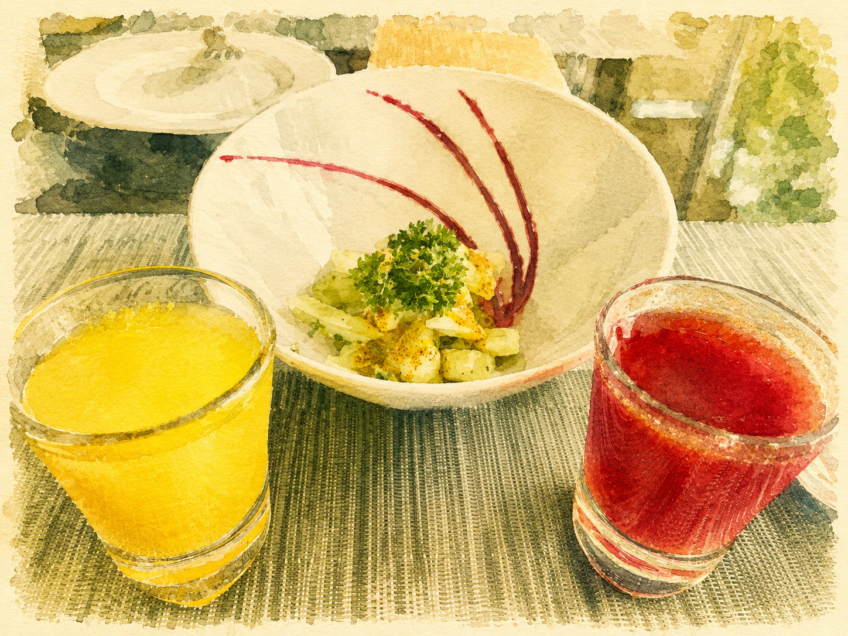
    Breakfast began with morning shots — turmeric, amla, wheatgrass — followed by smoothies. The Kale-Spinach-Date smoothie was a personal revelation: something that sounds like punishment and tastes like a decision you’ll be proud of. Chia seed fruit bowls, grain-free idli, and fresh fruit rounded out the morning.

    Lunch was the main event: soups, salads dressed with cold-pressed oil and herbs, grain-free rotis made from banana stem flour and cassava, vegetable curries stripped of excess masala and oil. Desserts for those whose plans permitted: carrot kheer, chana kheer, date cake — all made with natural sweeteners, all genuinely delicious. On the last day but one we also got to celebrate with a grain-free pizza!

    Dinner was lighter: lentil soups, carrot-orange soup (which sounds wrong and is extraordinary), broths, and clean main courses. Water was served in measured amounts — a small but pointed lesson about over-consuming water with meals and diluting digestive enzymes in the process.

    There are 110 juice combinations and 30 shot variants available. I did not try all of them. But I tried enough to conclude that wellness food has been liberated from its own mythology. The question is no longer whether it can taste good. It demonstrably can.

    We often think transformation requires deprivation. Atmantan reminded me that transformation can also be delicious.

    Perhaps the most surprising outcome was what I stopped consuming. I spent eight consecutive days without tea — no small achievement for someone who considers ginger chai one of life’s great inventions. By the third day, I had stopped missing it. By the seventh, I had stopped thinking about it. The body, it turns out, can be surprisingly adaptable when given the chance.

    The Cooking Class

    One afternoon, the kitchen opened to guests in the Soulful Spoon studio. A live demonstration covered the cuisine philosophy, sourcing principles, and the surprisingly creative substitutions Atmantan employs to make healthy food both nutritious and genuinely enjoyable. We learnt to prepare a carrot-orange soup, a grain-free kofta made using watermelon seeds, and a cassava roti. The session felt less like a cooking class and more like an invitation to rethink everything we assume about healthy eating. We were encouraged to taste at every stage, understand the reasoning behind each ingredient, and carry the ideas home with us.

    The Atmantan Tribe – The People Who Make It Real

    A wellness retreat is ultimately a human institution. The architecture, the views, the programme design — these set the stage. What fills it is people: the staff who show up with knowledge and warmth in equal measure, and the guests who bring their particular wounds and curiosities and become, over seven days, something like community.

    The Atmantan Team

    Atmantan’s team is drawn from across India — Kerala, the Northeast, Maharashtra, Odisha, West Bengal, Madhya Pradesh. Brief conversations between treatments yielded fragments of remarkable life stories. These are people who chose this work, and it shows in how they do it.

    1. Dr. Navya – Consulting Physician

    Patient, rigorous, and genuinely curious about each guest as a medical case worth understanding. The week’s anchor.

    2. Rahul, Amresh, Siddhi, Vandana, Abhishek – Yoga & Fitness

    Practitioners with deep, practical knowledge who could simultaneously correct your Warrior II and explain the neurological logic behind Pranayama.

    3. Pragati & Biswajit – Wellness Coordination

    The infrastructure that made the plan work day to day. When therapies collided in the schedule, they resolved it quietly, without fuss.

    4. Asha – Dining Coordination

    The face of Atmantan. Three times a day, without fail, the most energising human presence in the building. Guests didn’t walk to lunch — they walked to Asha. Her warmth was not performed hospitality. It was the real thing.

    5. Amrit, Agnes, Ankita, Amber, Mohasin, Krishna – Kitchen & Dining

    Fed us like Goddess Annapurna — with smiles, care, and the occasional firmly enforced dietary boundary when we attempted to negotiate our way to chai-pakoda during the rains. Neither our emotional appeals nor alternative proposals could move them!

    The Atmantan Guests

    The Atmantan guest mix is not what the wellness-retreat stereotype might suggest. Yes, there were middle-aged professionals seeking lifestyle recalibration. But there were also young people — eighteen to twenty-two years old — who had made a deliberate, self-directed choice to invest a week in their long-term health before life’s pressures compounded.

    An Ivy League student traded notes on therapies with a fintech entrepreneur. The senior government official exchanged notes with a Gujarati businessman.

    Atmantan guests came from all over the world – Chile, Malaysia, Dubai, Europe, USA etc. We exchanged stories on Atmantan, work, and overall life. Apart from global citizens, there was a big group from The United States of Ahmedabad – Panjrapole, Vastrapur, Satellite, Navrangpura etc. There is a clear case for Atmantan 2.0 in Ahmedabad or near Ahmedabad.

    The digital detox — strictly enforced, no network in common areas or restaurants — compressed the usual social performance and opened something more honest underneath. Instead of connecting with a tribe of influencers, you connect with strangers who, by day four, feel like old friends

    NEXT: Part 4  —  The Transformation

  • Atmantan Diaries: The Timeless Therapies & Trek

    Atmantan Diaries: The Timeless Therapies & Trek

    The Atmantan Method: Therapies & Activities

    Atmantan does not offer a menu of generic spa services with vaguely Sanskrit names. Its practitioners — many from Kerala, others from the Northeast, Maharashtra, Bengal, Odisha — carry knowledge and technique that can be immediately distinguished from the decorative massages of a five-star hotel. You feel the difference within minutes.

    We experienced the following therapies and activities:

    1. The Morning Yogic Kriyas

    Each day opened with Yogic Kriyas — a systematic cleansing sequence rooted in Hatha Yoga. Neti: warm saline water flowing in through one nostril and clearing through the other, purifying the sinus passages. Gargling: deep-throat cleansing that most of us have never done properly. Eye exercises: thirty rapid blinks, followed by six deliberate rotations in each direction — left, right, up, down, clockwise, counter-clockwise — reactivating the ocular muscles grown lazy under fluorescent light and screen glare.

    It sounds clinical in description. In practice, especially at six in the morning with mist on the valley below, it felt like an act of genuine self-regard — the deliberate care of a body one has perhaps been taking for granted.

    2.  Laghu Shankha Prakshalana — The Great Internal Rinse

    LSP is one of the more extraordinary experiences available to the guest willing to surrender ego for approximately ninety minutes. The name comes from Sanskrit: shankha — the conch shell, referring to the entire alimentary canal from mouth to anus — and prakshalana — to wash completely. It is exactly that.

    The practice: warm saline water consumed in measured rounds of two glasses, interspersed with five specific yoga asanas that mechanically move the water through the digestive tract. Round after round, the process continues. The body begins to release — solid waste first, then progressively clearer, until what emerges is essentially the clean water you drank, signalling a genuinely emptied and flushed gastrointestinal system. One returns to the room afterwards and eats, as prescribed, a plain moong dal khichdi with a touch of ghee — a meal that lands like a blessing in a body that has just, perhaps for the first time in years, been completely clean inside.

    LSP can be practised once every one to three months. We intend to make it an annual ritual — and are quietly planning to introduce our children to it under proper guidance.

    3. Massages — The Art That Will Not Be Taken Away By AI

    Atmantan’s therapists operate on a different register from any spa massage I have experienced. These are practitioners who use not just their hands but their forearms, elbows, and body weight — redistributing energy rather than simply applying pressure. Each therapy comes with a verbal brief: what it does, why it has been prescribed for you, what to expect.

    The Green Tea Scrub lifts dead skin and awakens circulation, leaving the skin with an improbable smoothness.

    Manual Lymphatic Drainage — through light, rhythmic strokes following the lymphatic pathways — restores flow to a system congested by travel, desk work, and stress.

    The Signature Atmantan Massage uses warm basalt stones alongside oils specific to the season; the stones allow the therapist to work at a depth impossible with hands alone.

    Udwarthanam — a two-therapist Ayurvedic treatment of simultaneous upward massage with warm herbal paste — is both exfoliating and deeply stimulating.

    The Chi Nei Tsang (Abdominal Massage) devotes fifty focused minutes to the gut: confronting and liberating in equal measure, releasing not just physical tightness but, for many guests, something more layered and harder to name.

    4. Fitness – Moving The Body — Multiple Ways To Sweat

    Daily group activities include Pilates, Aqua Aerobics, Yoga, Zumba, Bollywood Dance, Pranayama, and Laughter Therapy — a session which initially produces self-conscious, performative laughter and then, surprisingly, genuine laughter, which seems to be the point.

    Bollywood Dance deserves a special mention. Forty-five minutes disappeared in what felt like five. Somewhere between awesome choreography, enthusiastic participation, and a soundtrack that refused to let anyone remain serious, fitness quietly disguised itself as joy. It was one of the few workouts I wished had lasted longer.

    The highlight was Neuro Reactive Training — a methodology built on dynamic, unpredictable stimulus-response sequences that challenge the brain and the body simultaneously. Eight stations, one minute each: strength, reflexes, balance, coordination, explosiveness — all demanded in rapid succession. After years of repetitive gym routines, this was the most genuinely stimulating physical experience I can recall. The adrenaline was real. I was grinning uncontrollably by station five.

    5. The Daily Meditation – Sitting With The Soul

    Every evening, after the body had been stretched, pressed, challenged and nourished, the soul was invited into the conversation.

    We experienced meditation sessions that spanned multiple modalities: Twin Heart Meditation (moving attention through the heart centre and crown before radiating compassion outward), Chakra Meditation, Trataka (candle-gazing, one of the classical concentration practices of Hatha Yoga), and Omkar — the resonant, sustained intoning of Om that one dismisses as cliché until one actually does it properly and feels the vibration move through the chest cavity and into the skull.

    Some were familiar. Some were new. All of them created pauses.

    I realized something simple: I have spent much of my life sharpening the mind. In recent years, like many of us, I have also become more conscious of the body. But the soul — that quiet, luminous, inner dimension — often gets leftover attention. No popular metric tracks it. No biometric captures its state. And yet its neglect is quietly felt everywhere.

    Atmantan gently restores the triangle.

    Body. Mind. Soul.

    Not as a slogan. As a lived sequence.

    6. The Sahyadri Trek — Where The Mountain Becomes The Medicine

    On Sunday morning, after kriyas, twenty-some guests from Chile, Malaysia, Dubai, the United States, Europe, and several postcodes of Ahmedabad assembled for a trek into the Sahyadri range. The hill was steep; the reward, comprehensive.

    At the summit, a small Ganesh temple. We stopped. The sky delivered a brief, perfect rain — just a few minutes of cool drizzle, as though on schedule. We ate slices of apple and pear and shared, in the way people do when they have just climbed something together, more of our lives than we would have at sea level. The descent was quicker. Conversations went deeper. The group — engineers, students, government officials, entrepreneurs, Ivy League graduates — had, for this hour, the same muddy shoes and the same enormous view.

    7. Grounding — The Oldest Medicine

    There is, in the Atmantan grounds, a dedicated barefoot walking path. Guests are gently invited — not instructed — to use it in the early morning.

    The practice is called Earthing, or Grounding. When bare skin contacts the Earth’s surface — grass, soil, wet stone — a transfer of electrons occurs. The Earth carries a net negative charge; the human body, perpetually exposed to electromagnetic radiation from devices and artificial lighting, tends to accumulate a net positive charge. Direct skin contact with the Earth neutralises this imbalance, restoring the body’s electrical baseline to something close to its evolutionary norm.

    The benefits documented in the peer-reviewed literature include reduction in systemic inflammation, improved blood viscosity, better glucose regulation, enhanced sleep, and reduced cortisol. These are not trivial effects from a trivial cause.

    Our Indian customs always said: remove your shoes at the temple, at the school, entering the home. We dismissed this as ritual. It turns out it was also physiology. The ancients, working by inference and observation across millennia, had arrived at the correct answer.

    I walked barefoot on the grass every morning. By day seven, I was doing it before breakfast without thinking about it. That, I have come to believe, is how the best of what Atmantan teaches actually travels home — not as a resolved intention, but as a new habit so quietly embedded it has already stopped feeling like effort.

    Digital Detox: Watching Nature Instead of Reels

    One of the most powerful therapies at Atmantan is not listed as a therapy.

    Disconnection.

    There was limited connectivity in common areas. Wi-Fi was mostly functional in the rooms. This changed the energy of the stay. Restaurants became places of conversation. Walkways became spaces of observation. Mornings became softer. Nights became quieter.

    Instead of watching AI-manufactured reels, we watched the play of nature.

    Instead of scrolling through other people’s lives, we listened to our own.

    I rediscovered the joy of reading a book while the breeze and sunshine sat beside me like old friends. I remembered that boredom is not an enemy. It is often the doorway through which reflection enters.

    NEXT: Part 3  —  The Food & The Atmantan Tribe
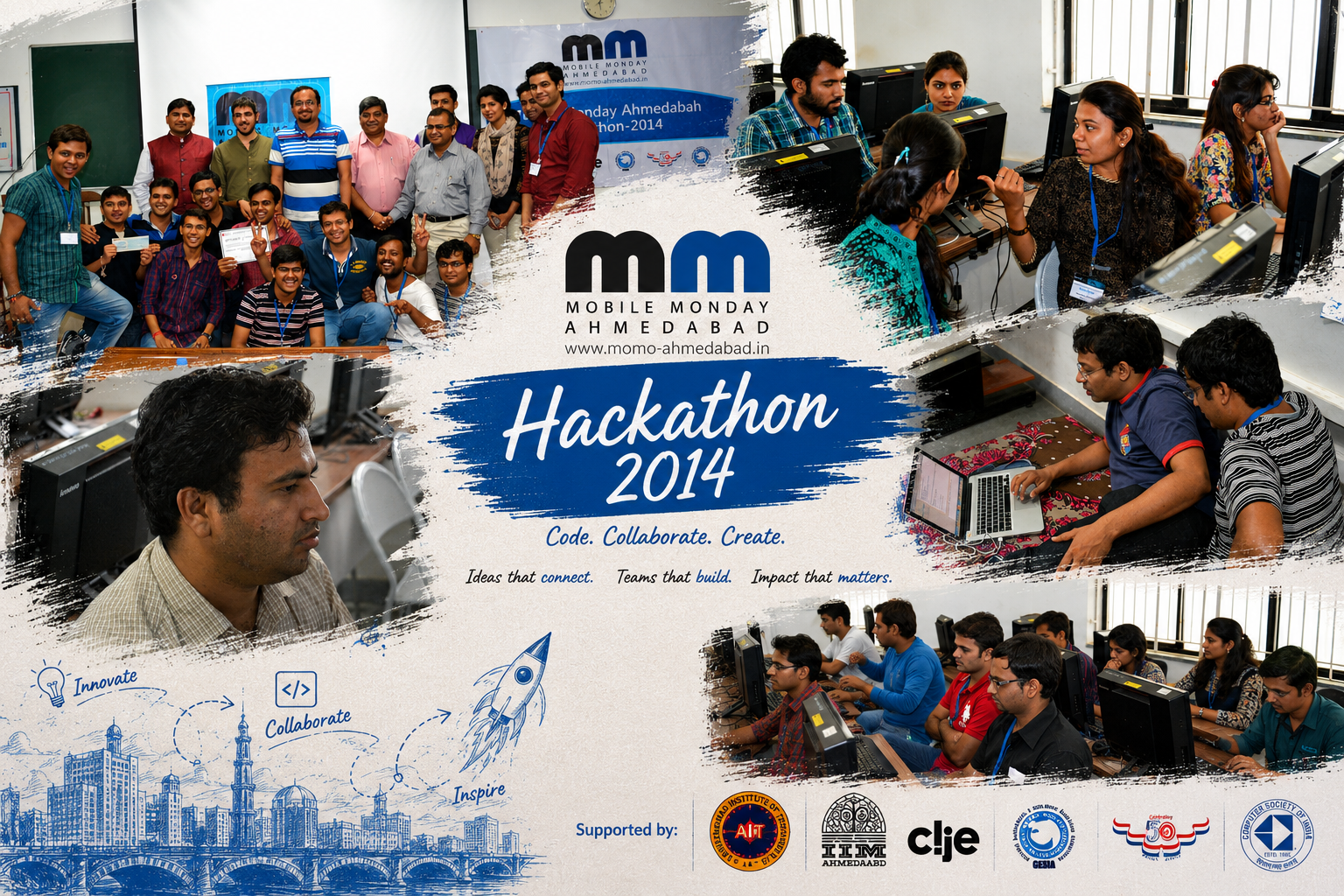
  • Hello Bachchon Review : Predictable Plot, Powerful Purpose

    Hello Bachchon Review : Predictable Plot, Powerful Purpose

    In a country obsessed with unicorns, Hello Bachchon reminds us that the most valuable startups are the ones that create human potential.

    Education is the passport to a better life. For millions of less-privileged Indian children, it is the only magic wand — the one equaliser that can transform a destiny. And it is these very children who will power India’s ascent to becoming an unquestionable superpower.

    Hello Bachchon tells the story of Physics Wallah founder Alakh Pandey and the rise of one of India’s most influential EdTech companies. On the surface, it is a familiar rags-to-riches journey. At times, it feels like a sanitized corporate success story, and fans of TVF’s Kota Factory or Aspirants may find the narrative predictable.

    Yet, the series succeeds because its heart lies elsewhere.

    What stayed with me were not the business milestones, valuation headlines, or unicorn status. It was the stories of the students.

    A young boy battling financial hardship. A young girl fighting social expectations that threaten to end her education prematurely. Another quietly setting aside his love for cricket to shoulder family responsibilities. Through their journeys, we are reminded that education is not a privilege for a fortunate few—it is a life-changing force capable of altering destinies.

    Viineet Kumar Siingh delivers a sincere and compelling performance as Alakh Pandey—a teacher whose belief in affordable education remains stronger than the lure of commercialization. His Alakh is idealistic, imperfect, passionate, and deeply committed to the students he serves.

    The series also highlights a truth we often overlook: India’s rise in entrepreneurship, sports, science, and the arts is being powered by countless young people from ordinary backgrounds who simply need access, opportunity, and someone who believes in them.

    That is why Hello Bachchon resonated with me.

    A series every Indian parent, student, teacher, entrepreneur, and policymaker should watch.

    More than the story of an entrepreneur, it is the story of hope. The story of education as social transformation. The story of what becomes possible when purpose is placed above profit.

    We need more institutions that democratize opportunity.

    We need more social entrepreneurs who choose impact over valuation.

    May a thousand Alakh Pandeys bloom in India. 

    #HelloBachchon #PhysicsWallah #AlakhPandey #SocialImpact #Education