Author: afnan_bukhari

  • Atmantan Diaries: The Art Of Aliveness

    Atmantan Diaries: The Art Of Aliveness

    .We Arrived Hoping to Improve Our Health. We Left with a Different Definition of Wealth.

    Over the years, we have crossed many borders chasing sunsets, skylines, stories, and the occasional version of ourselves. This summer, we chose a different kind of expedition — inward. Not to a foreign shore, but to a quiet valley in the Sahyadris where the prescription for living well is written not in itineraries, but in rhythms.

    Five Truths That Seven Days Burned Into Me

    Before I tell you about the place, let me tell you what I brought home from it. These are the five things I now know that I did not know before:

    1.  The Holy Trinity:

    Soul, mind, and body are not departments in a building — they are one ecosystem. Neglect any corner and the whole suffers.

    2.  Food is Medicine:

    Simple, conscious ingredients — eaten in the right portion, at the right hour — have a pharmacological power we have cheerfully surrendered to processed shortcuts.

    3.  Rhythm Over Resolution:

    Sleeping at 10 and rising at 5 is not discipline — it is alignment. The body already knows what to do. Our job is to stop arguing with it.

    4.  Mindfulness Compounds:

    Awareness, once practised even briefly, accumulates. A week of attention to breath, posture, and plate changes what follows you home.

    5.  The Body Counts:

    We train our minds relentlessly and admire our balance sheets. The body — the only vehicle we cannot trade in — often gets a car-service appointment once a decade.

    Where the Sahyadris Meet the Self

    There are journeys that take us across oceans. There are journeys that take us across mountains. And then there are journeys that travel a far greater distance—the journey from the head back to the self.

    Over the years, I have wandered through more than sixty-five countries. I have watched the Northern Lights dance across Arctic skies, admired Gothic cathedrals in Europe, stood before ancient ruins, explored bustling cities and quiet villages, and collected enough passport stamps to fill several lifetimes of stories.

    Travel has always been one of my greatest teachers. Yet this summer, we chose a destination unlike any we had visited before.

    Instead of exploring another country, we decided to explore ourselves. Instead of seeking new landscapes, we sought a new perspective. Instead of visiting foreign shores, we embarked on a journey inward.

    That decision brought us to Atmantan.

    Nestled in the crystalline hills above Mulshi Lake, Atmantan is not a spa. It is not a hotel. It is not a resort in the way that word has been softened by Instagram. It is a considered, medically structured environment designed to make you uncomfortable in all the right ways — and then deeply, lastingly well.

    The name itself is a compass. Atma — soul. Mana — mind. Tann — body. The centre spans 36 acres of the Sahyadri range — recognised as one of the world’s eight hottest hotspots of biological diversity — overlooking the blue-green expanse of Mulshi Lake. The air here carries the scent of jamun and wet laterite. The light, filtered through the valley mist, arrives gently, even in summer.

    “I had braced myself for the usual wellness-retreat food — the steamed, the beige, the vaguely punitive. The bitter kadhas and punishing vegetables that haunted many Indian childhoods. What arrived was a Michelin moment: vivid, precise, layered with flavour.”

    The property rewards wandering: two salt-water pools, a Pilates studio, dedicated yoga pavilions, therapy suites, a barefoot walking garden where the earth beneath your feet is part of the prescription, and an organic farm from which a significant portion of what you eat tomorrow was growing this morning.

    Across the property, thoughtfully placed stations offered fruit- and herb-infused water. Every detail seemed intentional — glasses neatly arranged on coasters, replenishment appearing before it was needed. It reflected a broader truth about Atmantan: wellness here was not an activity. It was a design philosophy.

    A Day at Atmantan

    The day here has a rhythm. The rhythm grounds everything else.

    6:00 am  —  Yogic Kriyas

    6:30 am  —  Barefoot Walk / Hiking

    7:00 am  —  Morning Yoga & Pranayama

    8:00 am  —  Breakfast

    10:00 am  —  Therapy / Fitness Activity

    1:00 pm  —  Lunch

    3:30 pm  —  Health Talk

    5:00 pm  —  Therapy / Evening Yoga

    6:15 pm  —  Meditation

    7:00 pm  —  Dinner

    10:00 pm  —  Sleep

    It sounds simple. It is not. Because modern life has made simplicity very difficult.

    Medicine Meets Mindfulness

    Every guest at Atmantan begins with a doctor. Dr. Navya sat with us on Day One, having already reviewed our pre-submitted health reports. She asked the kind of questions a good physician asks: not the ones on the intake form, but the ones beneath them.

    The output of that first consultation was a week-long, personalised wellness plan — a schedule that interwove specific therapies, a customised diet plan (transmitted directly to the kitchen), daily fitness sessions, and the particular yogic kriyas most relevant to our constitution. A Body Composition Analysis followed, and its data was fed back into the plan to sharpen it further.

    A Physiotherapist evaluated our posture, movement patterns, and musculoskeletal health — providing a written assessment and corrective exercises that were both humbling and useful.

    Dr. Navya checked in regularly through the week. By the final morning, she presented a progress report, a two-week diet plan for home, and long-range health recommendations. She even shared recipes. This was not wellness as amenity — this was healthcare as hospitality.

    The guests we met came for vastly different reasons. Some sought weight management. Others, detoxification, Ayurvedic Panchakarma, post-illness recovery, or yoga immersion. Several were veterans — on their fifth or sixth visit — who had built Atmantan into an annual rhythm, the way one services a complex machine.

    That was indeed a thought worth sitting with – We service our cars religiously. The body? Maybe once in forty years, if the engine light comes on.

    NEXT: Part 2  —  The Body : The Art That Will Not Be Taken Away by AI

  • What Is Enough: The Only Question That Survives the Climb

    What Is Enough: The Only Question That Survives the Climb

    The cabin was empty. She was the only passenger in the first-class compartment, somewhere between the closing dinner and the next morning’s press release. The deal in her briefcase would, when she signed it on Monday, take her firm into a different weight class — a mega institution, the kind of client she had spent a decade learning how to win. The plane was returning her, with the press release already drafted, to a city where her husband and her young daughter were asleep.

    And then, somewhere between the meal service and the descent, she began to cry.

    She tells the story carefully when she tells it now, because she needs you to understand one thing about her: she did not cry. Not as a partner at McKinsey. Not as the young woman who had walked down Park Avenue at midnight in a sari, with two suitcases and no hotel room. People who know me will tell you I’m just not a crier. Even when I was little, I wouldn’t cry.

    She did not know why she was crying. It was not sorrow. It was not regret. The book in her hands was Autobiography of a Yogi. The deal was not a bad deal. The career was not a wrong career. And yet the tears kept coming, all the way to the descent.

    On Monday morning, she called the client. She told them she could not sign. The press release would have to be killed. The deal — by then nearly two years of work — would have to be handed back. They told her she was crazy. She knew she was not.

    The decision cost her a great deal. It took her months to undo what the next twenty-four hours of her life were supposed to do. But the question that had arrived uninvited in the first-class cabin, without sorrow and without reason, did not leave her. It only got larger.

    I will make more money. I will have more fame. And when does it stop. What is enough.


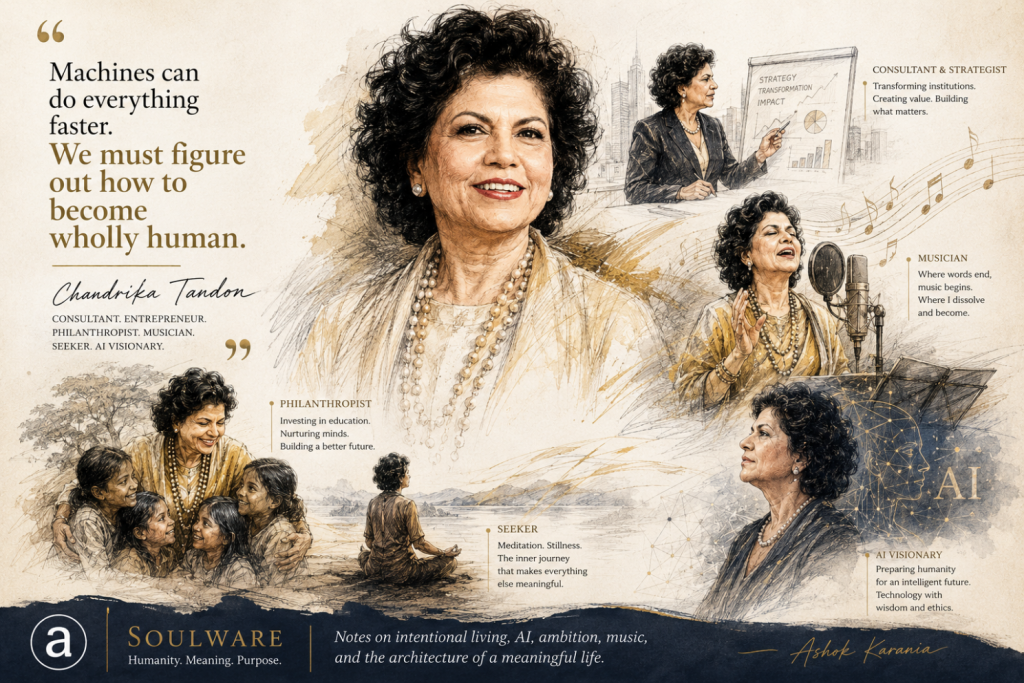
    I watched the WIMWIAN Trailblazers podcast featuring Chandrika Tandon . The conversation was recorded at Indian Institute of Management Ahmedabad — she was back for her fiftieth reunion, the first guest of a new podcast the endowment fund had built to listen to its own.

    And the moment I keep returning to is not the Grammy. It is not the hunger strike at seventeen. It is the cabin. The tears of a woman who did not cry. Because what arrived on that flight was not a midlife crisis. It was a question. And the question is the same one that, at a certain hour in a certain decade of a certain kind of life, arrives uninvited at the door of every serious person.


    To understand the question, you have to understand what was sitting in the briefcase on the seat beside her.

    She had reached, by then, a place few advisers reach in any market in any decade. Her firm — which she had started by liquidating her own retirement savings, by bleeding money for eleven months without a single client, by signing paid-on-success contracts because she was that certain of her formula — had become a discreet engine of restructuring at the centre of American banking. She had taken a bank whose stock traded at a dollar and five-eighths and walked it, in four years, to sixty-one dollars a share. She had done it again, and again. She was, at one point in her career, a disclosable event for the SEC: when a bank hired her, they had to file. The stock would move on the news of her name. People called her office at odd hours just to learn which town she was flying to, so they could guess which bank might be next.

    The deal in the briefcase was the next size up. It would have moved her firm from the company of advisers into the company of the institutions they advised. It was, in every external sense, the deal of a career.

    She did not sign it.


    What she did instead, in the months and years that followed, was strange in the way that intentional lives are always strange to those still living accidentally.

    She began, at the same age at which her contemporaries were preparing to slow down, to learn music seriously. She had sung all her life — when I hear an air conditioner, I am making a tune; when I hear the sound of thunder, I am making a tune — but always around the edges of the work. Now she wanted the masters. The masters do not take pupils in middle age; they take them at four. So she became, in her own phrase, a music beggar. She found a Carnatic teacher at Wesleyan University, two hours from her Manhattan apartment, and she asked him for a 6 a.m. Saturday class because it was the only window her life left her. He kept refusing. She kept asking. He finally agreed.

    For a year and a half, every Saturday, she set her alarm for half past three. She walked out of her building. She de-iced her car — sometimes for an hour, at two thirty in the morning, because the car was parked on the street. She drove the two hours with the cassette playing the scales she would be tested on. She sat in his living room from six to eight. She drove the two hours back. She bought a muffin on the way. She was home by quarter past ten, in time to wake her daughter.

    She was at the time still running her firm.


    The music was the first of the journeys. The giving was the second.

    She did not begin with a cheque. She walked into NYU one afternoon — it was the closest serious institution to her apartment — and she asked the dean whether she might be useful. Can I please give myself. She offered a few hours a week as a mentor. They asked her to be the Distinguished Executive in Residence at the Stern School. Three hours a week became three days a week. She taught classes. She sat in on faculty lunches and interrogated the professors about their research. Several years in, the president of NYU invited her to join the board. From the board of NYU she became chair of the engineering school, which has since taken her family name. The Tandon School of Engineering at NYU. The Boyd Tandon School of Business at Madras Christian College. The Krishnamurthy Tandon School of Artificial Intelligence at IIMA Ahmedabad — the institution that is now hosting the conversation in which she is telling the story.

    She has a rule for any of it. Time, talent, and treasure must align. If she cannot give all three — if she cannot get inside the project, learn it, walk it into being — she does not write the cheque. The cheque is the lightest of the three. The hardest is the time. Anyone can give what is in their account. Few can give what is on their calendar.

    She has a phrase for the kind of work this becomes, and it is, I think, the most beautiful phrase in the conversation. We have a lot to learn from people who planted these banyan trees we are all sitting in the shade of. The image is older than her. It is older than any of us. But the people who actually plant banyans in their lifetime are rare, because banyans do not grow in your lifetime. They grow in someone else’s. To plant a banyan is to give shade to a child you will never meet.


    But the question has not yet arrived.

    The question arrives when she is asked, late in the conversation, about the world her grandchildren will work in. Her register changes — no longer the register of a woman remembering, but of a woman watching. She has just met, she says, a senior executive in the United States who is now running a company with annual revenues of a hundred million dollars and a single employee. He had been running it before, she says, with seventy-eight. She wonders aloud what becomes of the seventy-seven. She says, almost in passing, that the speed of all of this means we will be in continuous beta mode for the rest of our working lives.

    Then she says the line that, when I heard it the third time, I went back to the transcript and underlined.

    Machines can do everything faster. Machines have got domain knowledge. We have to figure out how to be wholly human.

    Becoming wholly human, she says, is becoming more centred. One cannot have a moral compass if one is stressed out inside. One cannot, she says, be a boat that carries others across the water if one’s own boat is full of holes.

    Years after the flight, in a podcast taping at IIMA Ahmedabad, she would say something else — quietly, almost in passing.

    If I died right now, I would have zero regrets.

    It was, in its own way, the answer to the question that had arrived uninvited in the cabin.


    The cabin, then, was not a turning point. It was a hearing. The question had been in the air for some time. The first-class compartment, with its empty seats and its single passenger and its Yogananda paperback, was simply the room quiet enough for her to hear it.

    Most of us will not get a cabin. Most of us will get a Tuesday morning. And the question, when it arrives — and it arrives, eventually, for anyone whose life is built on momentum — does not announce itself. It does not come dressed as crisis. It comes, sometimes, as tears with no obvious cause. It comes, more often, as the slow realisation that the calendar one is keeping is not the life one is living.

    Her answer turned out to be specific, idiosyncratic, a little inconvenient. Music at six on Saturday mornings. A board seat at NYU. A banyan-shaped school at the institution she had once been afraid to leave Chennai for. The shape of her answer is not the shape of yours. The shape of your answer is your own.

    But the question is the same. It is the only question that survives the climb.

    When does it stop. What is enough.


    This essay is a reflection on a conversation recorded for WIMWIan Trailblazers, the inaugural podcast series of the IIMA Endowment Fund, with Chandrika Tandon (PGP 1975) as its first guest. The full episode is available below.

    🎙️ Watch on YouTube: https://lnkd.in/gTizgv3Q

    🎧 Listen on Spotify: https://shorturl.at/KV9ua

    With gratitude to the IIMA Endowment Fund team for bringing this conversation into the world.

    #Soulware #SunshineLife #WhatIsEnough #IntentionalLiving #ChandrikaTandon #IIMA #Leadership

  • Palitana Diaries: 3,500 Steps. Four Friends. One Journey Within.

    Palitana Diaries: 3,500 Steps. Four Friends. One Journey Within.

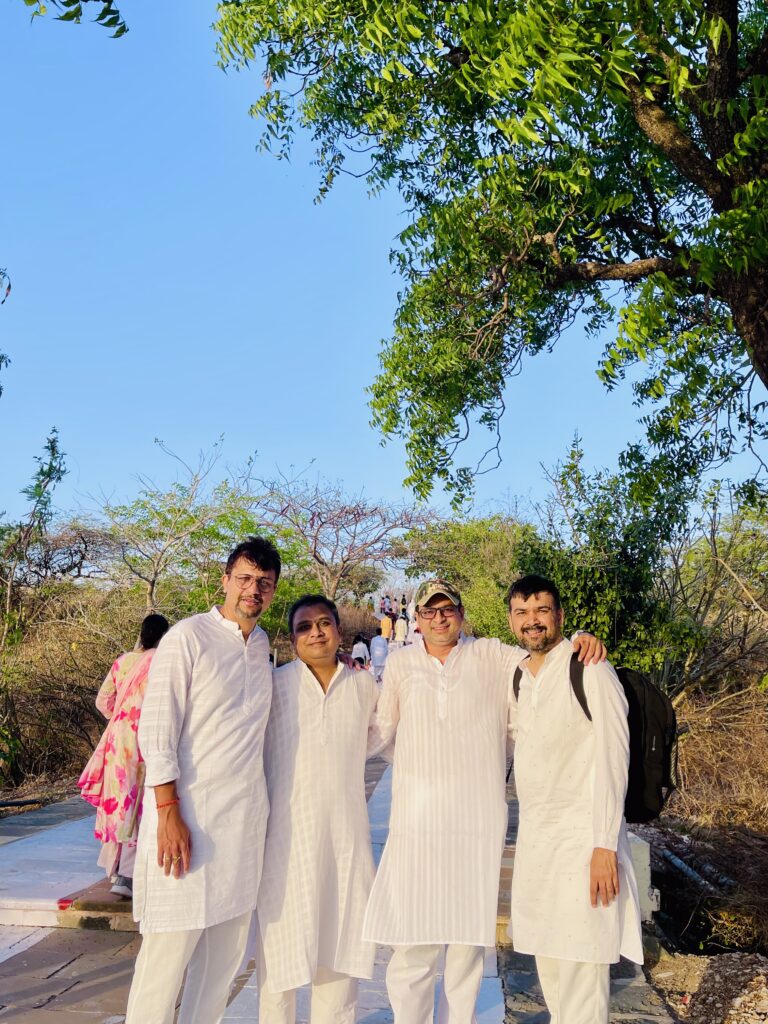
    Can Boys’ Road Trips Be Spiritual Yet Special? Showcasing snapshots from our journey to Palitana — the world’s only vegetarian city.

    Some journeys are measured in kilometers. Ours are measured in conversations, laughter, silence… and something deeper.

    The fabulous four—a quartet bound by friendship since our college days—have a tradition. Every few years, we escape. Not to luxury, not to indulgence. But to something far more grounding—spiritual sojourns.

    Our budget-tight, no-frills pilgrimage trips first taught us that the best memories rarely come from five-star hotels and world-class resorts. They come from shared rooms, from discussions over the dinner options, from quiet moments in temple courtyards — and from the friends who keep showing up, decade after decade.—these journeys have stayed with us longer than any designer experience ever could.

    The Road That Brings You Back

    This time, it began with a simple thought. Chi Chi expressed a desire to visit Palitana. Nayan turned intent into action—in days. Pratik enthused the group with his sporting spirit. A spontaneous plan. A familiar rhythm

    We rolled out on Saturday afternoon, fueled by a leisurely Agashiye Gujarati thali and the kind of optimism that only a 200+ km drive ahead can bring. The Ahmedabad–Dholera Expressway is a revelation — smooth, scenic, and a quiet testament to how fast Gujarat is reshaping itself.

    For us, though, distance has never been measured in kilometres. It’s measured in Raaz songs sung loudly and badly, in stories retold for the hundredth time, in debates about politics. By the time we pulled into Palitana, the journey had already done half its work.

    Palitana — Where Stillness Speaks

    Palitana is not just a destination. It is an divine experience. Words cannot describe the spiritual bliss. 

    Located in Gujarat’s Bhavnagar district, it is home to the world’s largest Jain temple complex—over 900 temples atop the sacred Shatrunjaya Hill. A city where vegetarianism is not a choice—it is a way of life. A place where even the air feels quieter, more aware. The pilgrimage’s flagship temple is dedicated to Rishabhdev, the first Tirthankara. 

    We arrived in the evening, had a meal before sunset, and made our way to the Shatrunjay river for the aarti — a quieter cousin of the Ganga Aarti, but no less moving. Shatrunjay Aarti was special —soft flames, rhythmic chants, and a sense of surrender that words rarely capture. 

    Then came the part I love most about these trips: wandering through a small town as it winds down for the night. Something about these places — the unhurried streets, the familiar smells, the easy nods between strangers — that no big city can imitate.

    The next morning began at 4 am and we started our ascent at 5 am. Over 3,000 steps lay between us and the summit. We drank no water until 7:30; Nayan, ever the disciplined one, had none at all. The body tires. The mind negotiates. But somewhere along the climb… something shifts. And then you arrive.

    At the top—amidst white marble temples, carved devotion, and centuries of faith—there is a moment.

    A pause. A presence. A feeling that you didn’t come here alone… you were called.

    Darshan. Pooja. Gratitude.

    Some experiences are not meant to be explained. Only felt.

    I felt blessed simply to be there.

    The descent was tougher. The sun harsher. The heat relentless. By the time we reached down, exhaustion had quietly set in. 

    And then we saw them. Young kids. On a mission to climb the hill 108 times in 30 days. Suddenly, fatigue felt… small. Perspective has a strange way of finding you when you need it most.

    We reached and were welcome back with refreshing fennel seed jaggery water and simple food to re-energize us. We took a bath and rested for a while. 

    By evening, we were back exploring the town: Mehta’s famous pendas, gulkand sweet enough to slow you down, and Palitana’s own version of Jain bhel — no onion, no garlic, all flavour. And after a quick South Indian dinner, we commenced our return journey to Ahmedabad.

    Bonding Beyond Bandwidth

    As we recollected the spiritual bliss and small town beauty, we knew what was the real highlight. 

    Us.

    We talked till 1 am that first night. Despite the long drive. Despite the early start the next morning. Because some conversations only happen face to face — not on Zoom calls, not in WhatsApp groups, not in the five-minute “how are you doing” check-ins that pass for friendship in adult life.

    We teased each other like we were twenty again. We debated Diwali market predictions and what life might look like beyond it. We got philosophical at hours when we should have been sleeping. And somewhere between the climb, the chai, and the laughter, the trip stopped being about Palitana and became about us.

    Because friendship doesn’t need an agenda. It just needs time.

    So… Can Boys’ Road Trips Be Spiritual Yet Special?

    Yes.

    They can be chaotic and calming. Loud and deeply silent. Fun… and profoundly spiritual. 

    They can be silly. They can be both at once. And every now and then, they remind you why some friendships are worth driving 200 kilometres — and climbing 3,000 steps — for.

    Because spirituality is not always found in isolation. Sometimes, it is found—

    In shared climbs.

    In tired smiles.

    In inside jokes.

    In journeys that take you back… to yourself.

    #RoadTripDiaries #Palitana #SpiritualJourney #FriendshipGoals #SoulfulTravel #IncredibleIndia #GujaratTourism #Shatrunjaya #BoysTrip #TravelWithPurpose #MomentsThatMatter #Soulware #AshWrites

  • Head. Heart. Soul.

    Head. Heart. Soul.

    A heartfelt note for the graduating students of Eklavya, who will go further than they yet know.

    Last month, I stood in front of a hall of students at an Ahmedabad school— eighteen-year-olds about to walk out of the only world they had ever fully known into one that would not stop changing. I had few minutes. They had seventy years.

    There is a particular weight to that kind of room. The parents in the back, who had spent two decades putting these children through it, were waiting for something useful. The children themselves were waiting for something true. And I was thinking, as I always think before talking to young people, that whatever I said had better be the kind of thing a person could carry for forty years without it breaking.

    So I gave them three words.

    Head. Heart. Soul.

    I am writing them down here because I think they belong to more than one room.

    Head

    Keep your head curious. For the rest of your life.

    The world the eighteen-year-old of today is walking into is not the world we walked into. AI is redefining what work means. Half of what they have learned in school will be commodity within a decade. Their first job and their fifth job will be different industries. The skill that matters most is not what they know today but what they are willing to learn tomorrow.

    The most dangerous words a person can say after the age of thirty-five are I already know this.

    Be a lifelong learner. Learn, unlearn, relearn. Stay a student.

    There is a story I told them about the founder of their school, Sunil Sir, that I want to tell you too. He is the kind of man who walks into a room and you can tell, before he opens his mouth, that he is several things at once — entrepreneur, educator, sportsman, reader. The kind of man children call Dhurandhar.

    But here is the thing he tells on himself.

    Until Class XII, Sunil Sir had read very little. He grew up in the schools of Hyderabad and was, on his own account, unremarkable. Then a librarian — Mrs. Fatima at the Hyderabad Public School — opened a door for him. Books arrived. Then debates. Then drama. Then horse riding. Then a life across consultancy, packaging, pharmaceuticals, ADR, and finally a school of his own.

    The man who is now an institution was, at seventeen, a boy who had not yet been introduced to a library.

    This is what a learning curve looks like. Not a steady upward arc but a series of doors held open at the right moment by the right person. Your job, for the rest of your life, is to keep walking through them.

    Heart

    Keep your heart strong. The world is going to test it.

    You will hear no more often than you will hear yes. You will fail in front of people whose opinion you care about. You will feel, on certain Tuesdays, that the universe has personally decided to break you. None of this is unusual. All of it is part of the curriculum.

    The trick is to remember that no is not the end of a sentence. It is the end of someone else’s sentence. Your sentence keeps going.

    There is another phrase Sunil Sir uses that I have stolen and intend to keep stealing.

    He warned the parents in the room about becoming Dettol parents — the kind who sanitise every surface their child might brush against, who clear every obstacle from the path before the child arrives, who build a childhood so smooth it teaches the child nothing about friction. The phrase made everyone laugh. Then it made everyone uncomfortable. Then, in the way real phrases do, it stayed.

    A life worth living is not a sanitised life. It is a resilient one — and resilience is not a personality trait. It is a muscle, built by being allowed to fall. Build that muscle in the people you love. Build it in yourself.

    Even your failures, if you have lived properly, will be better than most people’s successes.

    Soul

    Keep your soul alive. This is the part most people forget.

    Find what makes time disappear for you — a sport, an instrument, a craft, a language, a cause, a corner of the world that calls you back. Whatever it is, do not let the years take it from you. The world will get loud. Everyone will have an opinion about your career. Few people will care about your soul.

    You will. Or you will pay for the neglect later.

    I have known too many men in their fifties who built brilliant careers and quietly misplaced their souls along the way. The career still works. The soul does not. The wife notices first. Then the children. Then, decades late, the man himself.

    Do not let that be you. Build a life with weather in it — work and stillness, ambition and rest, building and reading, the boardroom and the long walk. The Sunshine Life is not a slogan. It is the discipline of refusing to live one-dimensionally in a century that rewards you for doing exactly that.

    And one more thing. I told the students this last, but it should have been first.

    Give.

    You have all received more than you can ever return. From your parents. From your teachers. From a school that taught you what to think and, more importantly, how to think. From a country that gave you a passport and an education. From a century that handed you, almost as a parting gift, the most powerful tools any human generation has ever held.

    You did not build any of it.

    You can only do one honest thing with what you have been given. Pass it on. Help one person rise. Light one path. Plant one tree whose shade you will not see. The Eklavya tradition of Khari Kamaai — the small earnings the students themselves contribute to rural schools — teaches that giving is not what you do after you have enough. Giving is how you become enough.

    Sharing is not charity. Sharing is the condition of a soul that has remained alive.

    So I will leave you, as I left them, with the three words.

    Head. Heart. Soul.

    Keep your head curious. Keep your heart strong. Keep your soul alive. And when you can — give.

    Because the world ahead will not just need intelligent people. It will need thinking minds, resilient hearts, and generous souls.

    In a century that keeps changing the rules, the head helps us adapt, the heart helps us endure, and the soul helps us remain human.

    #HeadHeartSoul #Soulware #SunshineLife #WellLivedLife #LifeLongLearning #Generosity #Eklavya

  • The Quiet Rebellion

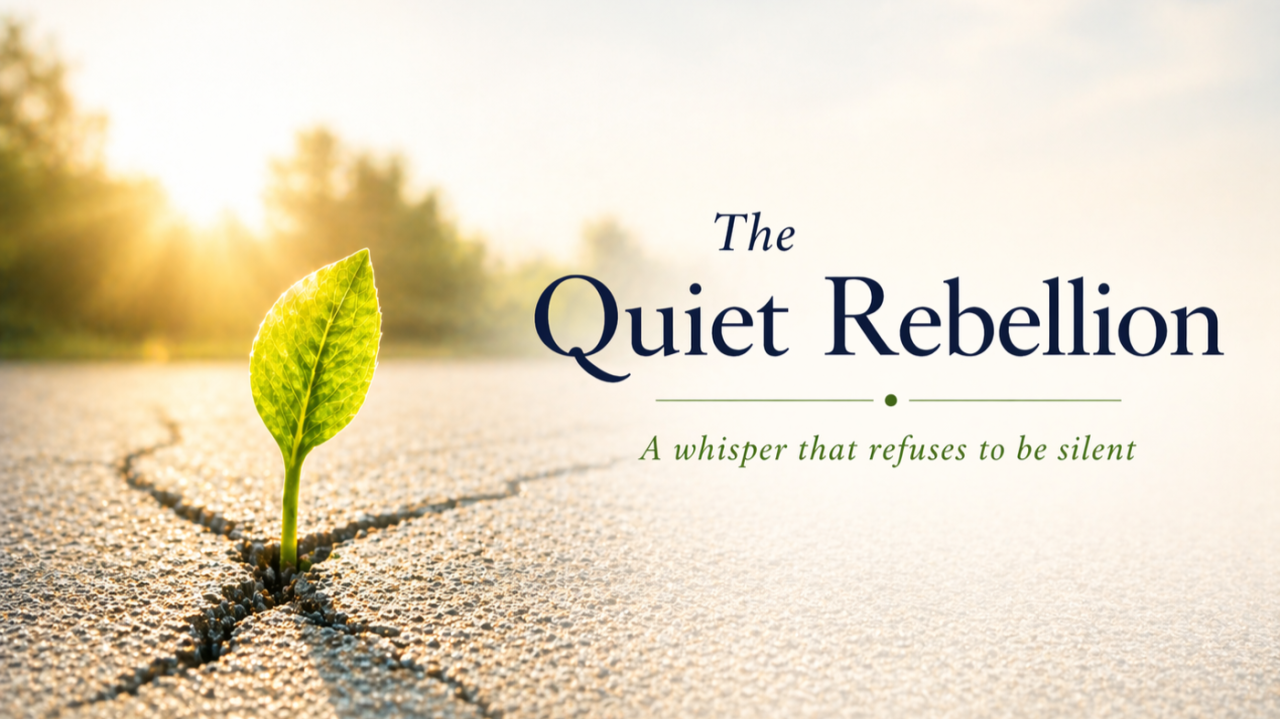
    The Quiet Rebellion

    We live in a world that rewards hatred.

    That celebrates self-interest.

    That mistakes cruelty for strength and calls compassion naive.

    The loudest voices today speak of division.

    The most viral content is outrage.

    The most powerful currency is fear.

    And yet.

    Nafrat ki duniya mein mohabbat ki baat karta hoon

    Jung ke maidaan mein insaaniyat ki baat karta hoon

    Satta ki bhookh mein jazbaat ki baat karta hoon

    Badle ki pyaas mein raahat ki baat karta hoon

    In a world screaming at the top of its lungs — this is a whisper that refuses to be silent.


    We have the intelligence.

    We have the technology.

    We have the progress.

    The question is not can we build a better world. The question is — do we still have the will to choose one?

    An eye for an eye will leave the whole world blind.

    The world does not need more noise.

    It needs more people who still dare to speak of love.


    Be that person.

    Not the one who was loudest.

    But the one who showed up.

    The one who refused to be swept away by the herd.

    The one who paused when everyone else was rushing.

    The one who listened to the heart when the world was all noise.

    The one who spoke for humanity when it was deeply unfashionable to do so.


    #AQuietRebellion #Soulware #StillHuman #BeТhatPerson #Sunshine #Purpose #Humanity

  • From Land to AI: The 7 Gates of Power That Control the World

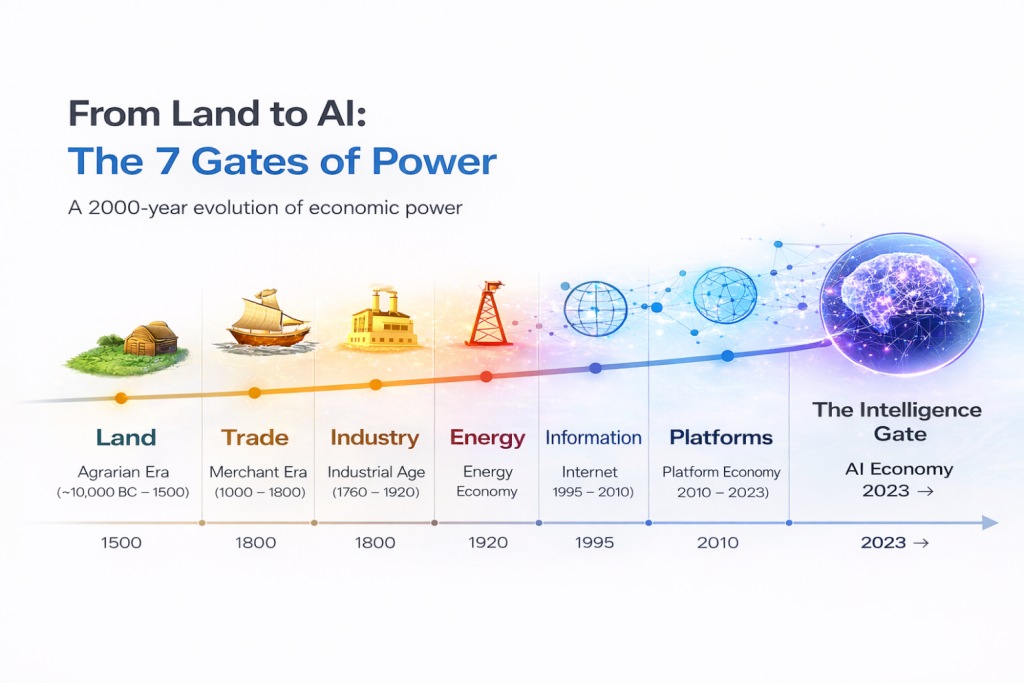
    From Land to AI: The 7 Gates of Power That Control the World

    Across history, power has rarely been random.

    It has almost always flowed through a small number of “gates.”

    Whoever controlled those gates shaped wealth, influence, and the direction of civilization.

    Every economic era has had its defining gate.

    And today, we are witnessing the rise of a new one.


    The 7 Gates of Power That Shaped the World

    1. The Land Gate

    Agrarian Civilizations

    For thousands of years, wealth came from land ownership.

    Land meant control over:

    • food production • taxation • political authority • armies

    Kings, emperors, and feudal systems dominated because agriculture powered economies.

    Insight: Power belonged to those who owned land.


    2. The Trade Route Gate

    Merchant Empires

    As global commerce expanded, power shifted from land to trade networks.

    Civilizations controlling the routes dominated global wealth:

    • Venetian merchants • Arab trading networks • Portuguese maritime empires • British shipping power

    Ports and shipping lanes became strategic assets.

    Insight: Whoever controlled the routes controlled the riches.


    3. The Industrial Gate

    Factories & Production

    The Industrial Revolution shifted power again.

    Factories enabled massive production of:

    • steel • railways • automobiles • machinery

    Industrial titans like Rockefeller, Carnegie, and Ford reshaped the economic landscape.

    Insight: Industrial scale replaced agricultural wealth.


    4. The Energy Gate

    Oil & Natural Resources

    The 20th century became the energy age.

    Oil powered:

    • transportation • manufacturing • logistics • military power

    Countries and corporations controlling energy infrastructure gained immense influence.

    Insight: Energy became the lifeblood of modern economies.


    5. The Information Gate

    The Internet Era

    The internet reshaped power dynamics again.

    Companies controlling information flows became dominant:

    • search engines • social networks • cloud platforms

    Data emerged as the most valuable digital asset.

    Insight: Information became more valuable than many physical resources.


    6. The Platform Gate

    Digital Ecosystems

    Platforms transformed the internet economy.

    Companies like:

    • Apple • Google • Amazon • Microsoft

    built ecosystems where others build businesses.

    Network effects made these platforms incredibly powerful.

    Insight: Platforms became the operating systems of modern commerce.


    7. The Intelligence Gate

    The AI Era

    We are now entering the Intelligence Economy.

    The next generation of power will come from controlling:

    • AI models • data ecosystems • compute infrastructure • autonomous agent systems

    Companies building this new foundation include:

    • OpenAI • Nvidia • Microsoft • Google

    Insight: Intelligence itself is becoming infrastructure.


    The Pattern Across History

    Article content
    Each Era Is Defined By Who Controls The Gates

    The Strategic Lesson

    Most organizations compete inside the system.

    The most powerful organizations build the gate itself.

    That is why:

    • Platforms beat products • Infrastructure beats applications • Ecosystems beat individual companies

    And now — Intelligence will beat software.

    A Final Thought

    History is not shaped by those who work the hardest.

    It is shaped by those who control the gates through which the world must pass.

    In the AI era, that gate is no longer land, energy, or even data.

    The new gate is intelligence.

    And the organizations that build the systems through which intelligence flows will shape the next century.


    #ArtificialIntelligence #AgenticAI #AILeadership #FutureOfWork #DigitalTransformation #AIInfrastructure #Strategy #Innovation

  • Physical AI: Real Power Drives Higher Purpose

    Physical AI: Real Power Drives Higher Purpose

    The screen is no longer the limit. AI has stepped into the physical world — and it’s moving faster than most leaders realize.

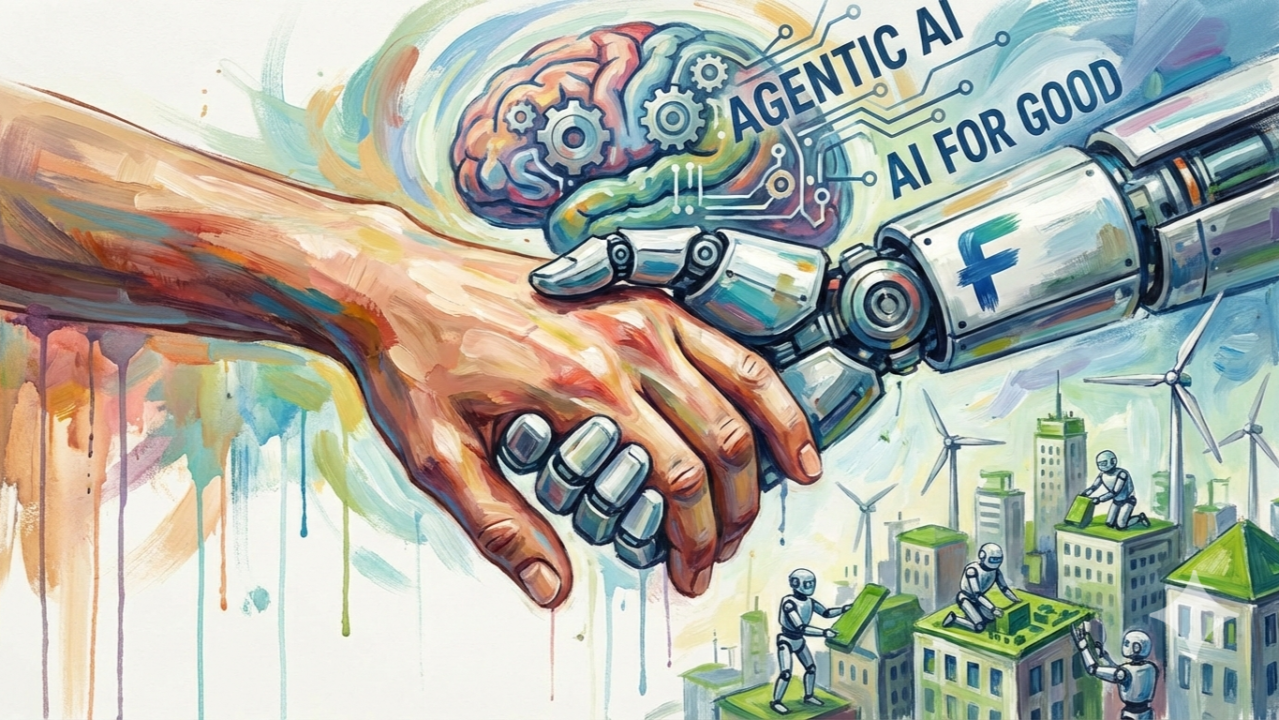
    For the last decade, AI lived behind dashboards and chat interfaces. Now, the digital “brain” of Agentic AI is gaining mobility, dexterity, and spatial awareness. Physical AI — embodied intelligence that can perceive, reason, and act in real-world environments — is transitioning from labs into the fabric of our 2026 reality. Analysts project this ecosystem to surge toward $60B+ over the next decade.

    This isn’t just about robots.

    From humanoids piloted in advanced manufacturing to autonomous fleets reshaping logistics and smart cities, Physical AI agents can now navigate unstructured environments — sensing, adapting, and executing in real time. This is where Agentic AI meets the real world: not systems that merely respond, but systems that act.

    Industries are being reshaped — manufacturing, warehousing, urban infrastructure, energy grids.

    But the true inflection point is healthcare.

    Globally, clinicians spend nearly 40% of their time on administrative and logistical burdens. Imagine humanoids managing hospital supply chains. Assistive cobots supporting elderly mobility with dignity. AI systems absorbing repetitive physical strain so caregivers can focus on what only humans can do — connect, comfort, heal.

    That is not automation. That is elevation.

    The real question isn’t whether Physical AI will scale.

    It will.

    The question is whether we build it only for efficiency — or for human flourishing.

    If we design Physical AI with sustainability, equity, and governance at its core, we unlock something far greater:

    • Reduced waste and optimized energy systems

    • Resilient, adaptive cities

    • Dignified aging supported by intelligent assistance

    • A workforce redirected toward higher-value, human-centric work

    This is where Agentic autonomy, AI for Good, and Sustainability converge.

    Technology is ready.

    Now leadership must decide the kind of human living experience we want this intelligence to enable.

    Because Physical AI won’t just change industries. It will redefine how we live with machines.

    Physical AI gives machines power. Purpose gives them meaning.

    #PhysicalAI #PurposeDriven #AgenticAI#AIforGood #PurposefulInnovation#Sustainability #HumanCentricAI#FutureOfWork #ResponsibleAI#Leadership

  • The Artist’s Discipline: Turning Intention into Mastery

    The Artist’s Discipline: Turning Intention into Mastery

    The Blueprint for Building Work That Matters – Turning the Seven Shifts into Lasting Transformation

    Welcome back, artist.

    If you’re reading this, you’ve spent time with the seven shifts from Part 1.

    How’s it going?

    Uncomfortable? Good. Transformation lives in discomfort.

    Guilty about what you’ve said no to? Perfect. You’re breaking patterns that weren’t serving you.

    Energized by deeper work? Excellent. That’s your soul remembering what it was built for.

    Now we go deeper.

    Part 1 gave you the foundation—the seven shifts that transform workers into artists.

    Part 2 is the blueprint—the systems, frameworks, and practices that make this transformation permanent.

    Because knowing the shifts doesn’t change your life. Implementing them does.


    The Excellence Equation

    Here’s how the seven shifts combine to create mastery:

    Excellence = (Deep Focus × Deliberate Practice × Consistent Recovery) ÷ Distractions²

    Deep Focus: Uninterrupted 90-120 minute blocks on your most important work. Pure, undiluted attention.

    Deliberate Practice: Not mindless repetition. Intentional improvement of specific skills with immediate feedback. Practicing at the edge of your ability.

    Consistent Recovery: Scheduled breaks, quality sleep, exercise, true downtime. Non-negotiable foundation.

    ÷ Distractions²: Distractions are squared—they multiply against you exponentially.

    One distraction = minor problem Two distractions = 4x the damage Three distractions = 9x the damage Four distractions = 16x the damage

    Every notification, meeting, and interruption compounds against your excellence.

    This is why “just checking email real quick” destroys deep work. You’re not losing 2 minutes. You’re losing 20+ minutes of recovery time to get back into flow state.


    The 3 Non-Negotiables of Excellence

    Skip any one, and excellence becomes impossible.

    Non-Negotiable 1: The 80/20 Ruthlessness

    20% of your efforts create 80% of your results.

    But we waste enormous energy on the 80% that barely moves the needle.

    Real examples:

    • 20% of your clients generate 80% of your revenue
    • 20% of your features drive 80% of usage
    • 20% of your hours produce 80% of your best work

    Most of what you’re doing doesn’t matter.

    Your Practice: The Brutal Audit

    Audit last month with complete honesty:

    Which 20% of activities produced your best outcomes? Which meetings moved things forward? Which hours were you in flow state?

    Now: Double down on that 20%. Eliminate or delegate everything else.

    One executive eliminated 60% of her meetings. Her team’s performance improved 40%.

    A designer cut his client roster by 70%. Revenue stayed flat. Quality tripled. Clients started paying premium rates.

    The pattern: Less activity, more impact.


    Non-Negotiable 2: The “Hell Yes or No” Filter

    Derek Sivers: “If it’s not a ‘Hell Yes!’, it’s a no.”

    Your time is the only truly non-renewable resource.

    Every “yes” to something is a “no” to something else.

    When you say yes to a mediocre opportunity, you’re saying no to a potentially great one.

    Most people say yes to too many things because they’re afraid of missing out, disappointing others, seeming uncommitted, or closing doors.

    Artists say no to protect their yeses.

    Warren Buffett: “The difference between successful people and really successful people is that really successful people say no to almost everything.”

    Your Practice: The 30-Day “Hell Yes” Experiment

    For the next 30 days, decline every opportunity that doesn’t make you say “Hell yes!”

    Not “this could be good.” Not “I should probably do this.”

    If it’s not “HELL YES!”—it’s a no.

    Track: Your energy levels, output quality, stress levels, sense of purpose.

    You’ll discover: When you say no to more things, the yeses become even more powerful. Your reputation shifts from “available for everything” to “exceptional at specific things.”


    Non-Negotiable 3: The Craftsman’s Patience

    Jeff Bezos: “We are willing to be misunderstood for long periods of time.”

    Excellence takes time. There are no shortcuts to mastery.

    Van Gogh sold one painting in his lifetime. Emily Dickinson published 10 poems while alive. J.K. Rowling’s Harry Potter was rejected 12 times. The Sistine Chapel took Michelangelo four years.

    The artist must be willing to do the work before the recognition comes.

    Your Practice: Choose Your 3-5 Year Project

    Most people overestimate what they can do in one year and underestimate what they can do in five.

    Choose one project with a 3-5 year timeline. Not a quick win. Not a viral hit. Something that requires deep, patient, consistent work.

    Examples: Write a book (the real way). Build a body of work that redefines your field. Master a craft to the level where people study your technique.

    No shortcuts. Just deliberate practice compounded over years.


    The New Metrics of Success

    Stop tracking what workers track. Start measuring what artists measure.

    Old Metrics (Worker):

    ❌ Hours worked

    ❌ Meetings attended

    ❌ Projects started

    ❌ Followers gained

    New Metrics (Artist):

    ✅ Hours in flow state

    ✅ Deep work sessions completed

    ✅ Projects shipped (completed)

    ✅ Lives changed

    ✅ Impact created

    What you measure shapes what you become.

    One founder: “I used to celebrate hitting $10M ARR. Now I celebrate when a customer says our product changed their life. The revenue still comes. But the meaning is the point.”


    The 30-Day Artist Experiment

    Theory without practice is just entertainment. Here’s your complete roadmap:

    Week 1: The Audit (Reality Check)

    Days 1-7: Track everything

    Log every hour in 30-minute blocks:

    • Deep work (creating, building, thinking)
    • Shallow work (email, meetings, admin)
    • Distractions (scrolling, interruptions)
    • Recovery (genuine rest, exercise, sleep)

    Identify your top 3 “time vampires”—activities that drain energy but produce little value.

    Calculate: What percentage of time goes to your craft vs. obligations?

    Most people discover they spend less than 10% of their time on what they claim is their priority.

    Week 1 Reflection:

    • Where did the time actually go?
    • When were you in flow state?
    • What felt meaningful vs. obligatory?

    Week 2: The Subtraction (Creating Space)

    Days 8-14: Say NO to 5 things

    Say NO to:

    • 2 recurring meetings that don’t serve your core goals
    • 1 project or committee you’ve been tolerating
    • 1 social obligation that drains you
    • 1 platform or newsletter you mindlessly consume

    Clear 10 hours for focused work this week.

    Block it in 2-hour chunks. Protect these blocks like your artistic life depends on it—because it does.

    Notice the guilt. Move forward anyway.

    The guilt means you’re doing it right. You’re choosing your craft over other people’s expectations.

    Week 2 Reflection:

    • How did it feel to say no?
    • Did the world collapse? (It didn’t)
    • What space opened up?

    Week 3: The Creation (Deep Work Immersion)

    Days 15-21: Block 2-hour windows daily

    The rules:

    • Phone off (not silent—OFF)
    • Door closed or noise-canceling headphones on
    • No email, no Slack, no “quick checks”
    • Work on ONE thing only

    Produce one meaningful output this week:

    An article, design, code feature, composition—whatever matters in your craft.

    Not perfect. Just real. Shipped. Done.

    The goal isn’t perfection. It’s completion.

    Most people have dozens of half-finished projects. Artists have a body of finished work.

    Week 3 Reflection:

    • How different was this work from your usual output?
    • When did you hit flow state?
    • What did shipping (not just working) feel like?

    Week 4: The Reflection (Integration & Commitment)

    Days 22-28: Assess and decide

    Quality shift:

    • How was this work different from what you normally produce?
    • What depth did you reach that you couldn’t before?

    Energy shift:

    • Are you more or less exhausted?
    • Where did you feel most alive?

    Integration questions:

    • Which practices will you keep forever?
    • What will you eliminate permanently?
    • What’s your one big takeaway?

    Days 29-30: Design your new normal

    Based on what you learned, design your ongoing practice:

    • How many deep work blocks per week? (Minimum 3, ideal 5-7)
    • What will you permanently subtract?
    • What boundaries will you set?

    Write it down. Make it concrete.


    The Artist’s Creed

    Print this. Put it where you’ll see it daily:

    I create before I consume.

    I protect my deep work like my life depends on it.

    I say no to good things to say yes to great things.

    I measure my worth by what I build, not how busy I appear.

    I honor the rhythm of creation and recovery.

    I seek mastery in one domain rather than mediocrity in many.

    I trust the process even when results are invisible.

    I am willing to be misunderstood on the path to excellence.

    I choose depth over breadth. Being over doing. Art over execution.

    I am not a worker. I am an artist.


    The Implementation Checklist

    Don’t just read this. Use it.

    This Week:

    • Complete your time audit (Week 1)
    • Identify your 80/20 activities
    • Choose your 3-5 year project
    • Block your first 2-hour deep work session

    This Month:

    • Complete the full 30-Day Artist Experiment
    • Say no to 5 things (minimum)
    • Ship one complete artifact
    • Find your council of 2-3 masters

    This Quarter:

    • Make 100+ hours of progress on your 1,000-day skill
    • Ship 12+ weekly artifacts
    • Eliminate 20+ commitments that don’t serve your craft
    • Build your creative monastery into an unbreakable habit

    This Year:

    • Transform your relationship with work completely
    • Build a body of work you’re genuinely proud of
    • Make real progress on your 3-5 year project
    • Live as an artist, not just work like one

    Your Next Move

    You’ve read the blueprint. You understand the equation. You have the complete 30-day experiment.

    The gap between knowing and doing is where transformation dies.

    Before you close this newsletter:

    1. Open your calendar right now

    2. Block tomorrow’s first 90 minutes for creation

    3. Start your Week 1 time audit

    4. Text one person your commitment

    5. Delete one time vampire permanently

    Do it now. Not later. Now.

    Because artists don’t wait for perfect conditions.

    They create the conditions. Then they create the work.


    The Final Truth

    The world has enough workers executing other people’s visions.

    It has enough people who are busy but not purposeful. Efficient but not excellent. Productive but not creative.

    The world is starving for artists.

    People who bring vision to their craft. Who choose depth over breadth. Who build things that matter. Who leave the world different because they had the courage to be themselves.

    You are that artist.

    Not someday. Today.

    The seven shifts are your foundation.

    The excellence equation is your formula.

    The 30-day experiment is your launch pad.

    Now go build something that matters.

    Join the Movement

    Want accountability and support?

    Reply with “I’m committed” and we’ll send you:

    • The 30-Day Artist Experiment tracker (printable PDF)
    • Weekly check-in emails to keep you accountable
    • Access to our private community of artists-in-progress

    But only if you’re serious.

    This isn’t for dabblers.

    This is for artists.

    #Soulware #WorkerToArtist #Part2 #ExcellenceBlueprint #30DayExperiment #DeepWork #BeTheArtist #Artist #Sunshine #Purpose

  • The Artist’s Awakening: The Seven Shifts That Make You Irreplaceable

    The Artist’s Awakening: The Seven Shifts That Make You Irreplaceable

    How to Recognize You’ve Been Living Someone Else’s Definition of Success

    There’s a moment that changes everything.

    You’re sitting in another meeting that could’ve been an email. Or staring at your inbox at 11 PM. Or celebrating a promotion that feels oddly hollow.

    And suddenly, you realize: You’ve been winning at the wrong game.

    You’re executing flawlessly. Checking every box. Climbing steadily. Getting validation.

    But something essential is missing.

    You’ve become exceptionally good at being a worker when you were meant to be an artist.


    The Brutal Truth About Workers vs. Artists

    Workers execute. Artists create.

    Workers follow the playbook. Artists write new chapters.

    Workers ask “What’s expected?” Artists ask “What’s possible?”

    Workers optimize for efficiency. Artists optimize for impact.

    Workers are replaceable by better workers—or increasingly, by AI. Artists are irreplaceable because they bring something unique: a vision shaped by a soul.

    Here’s the part that stings: This has nothing to do with your job title.

    You can be an artist in accounting, engineering, teaching, customer service—any field. The question isn’t what you do. It’s how you relate to your craft.

    Are you bringing artistry to your work? Or just completing tasks?

    Are you creating something that matters? Or executing someone else’s vision?

    Are you building a legacy? Or just building a resume?


    The Wake-Up Call: Five Signs You’ve Lost the Artist

    1. You’ve stopped feeling time disappear

    Remember when you used to lose yourself in work? When hours felt like minutes because you were so absorbed?

    Now you’re watching the clock. Counting down to 5 PM. Mentally checked out by Wednesday.

    That’s not burnout. That’s soul death.

    2. You can’t remember the last time you said no

    Your calendar is a monument to other people’s priorities. Every slot filled. Every request accepted.

    You’ve become a yes-machine. Efficient. Reliable. Completely drained.

    Being available to everyone means being present for no one—including yourself.

    3. Your best ideas come when you’re NOT working

    The shower. The commute. That moment before sleep.

    Why? Because your brain finally has space to think.

    If creativity only shows up when work stops, your work has become the enemy of your craft.

    4. You’re collecting credentials instead of creating value

    Another certification. Another course. Another “Top 10 Skills” list.

    But here’s the truth: No amount of credentials can substitute for a body of meaningful work.

    Picasso didn’t have an MFA. Shakespeare didn’t attend workshops. Steve Jobs didn’t finish college.

    They created. You’re preparing to create. See the difference?

    5. You measure success by what others can see

    The title. The salary. The LinkedIn endorsements.

    But privately? You feel empty. Because deep down, you know: None of this is actually yours.

    You’re living a life that looks impressive in other people’s eyes but feels hollow in your own chest.


    Why This Happens to Good People

    You didn’t start here.

    Remember your first day? You had ideas. Energy. Vision.

    Then the machine got you.

    Performance reviews that rewarded compliance over creativity. Culture that celebrated being busy over being brilliant. Promotions that came from saying yes to everything. Social media that turned your life into a performance.

    You didn’t lose yourself on purpose. You were trained to.

    The system doesn’t want artists. It wants reliable workers who execute and don’t ask questions.

    And slowly, imperceptibly, you became what the system needed instead of who you were meant to be.


    The Artist’s Mindset: 7 Fundamental Shifts

    What follows aren’t productivity hacks. They’re fundamental transformations in how you approach your craft.


    Shift 1: Cultivate Obsessive Curiosity in One Domain

    The lie: “Diversify your skills. Be a generalist. Keep your options open.”

    The truth: Mastery requires monogamy.

    Yo-Yo Ma didn’t spread himself across multiple instruments. He became the world’s greatest cellist through 10,000+ hours of deliberate practice. That depth created mastery. That mastery created artistry.

    Stephen King didn’t write equally across all genres. He went deep on horror fiction and became legendary.

    The world rewards specialists who become so good at one thing that they redefine the rules.

    Your Practice: The 1,000-Day Commitment

    Choose one skill to master over the next 1,000 days. Just one.

    Why 1,000 days? Because that’s when you cross from competent to exceptional.

    Go deeper than anyone else is willing to go. Read every significant book. Study every master. Practice daily. Document your journey.

    Because dilution is the enemy of mastery.


    Shift 2: Create Before You Consume

    How workers start their day: Alarm rings. Grab phone. Check email. Scroll news. Read Slack. Scan social media.

    By the time they “get to their work,” their mind is already colonized by everyone else’s priorities.

    How artists start their day: Create first. Consume second.

    Maya Angelou rented a hotel room every morning to write from 6:30 AM to 2 PM. No phone. No distractions. Creation first. Everything else second.

    Stephen King writes 2,000 words every morning—holidays, birthdays, weekends. The muse shows up because he shows up.

    The best work happens before the world wakes up. Not because mornings are magic, but because that’s when you still own your mind.

    Your Practice: Protect Your First 90 Minutes

    Starting tomorrow, the first 90 minutes belong to your craft. Non-negotiable.

    No “quick check” of email. No “let me see what’s trending.”

    Create something—write, code, design, compose, build—before the world makes demands on your attention.

    Do this for 30 days. You’ll produce more meaningful work in one month than you did in the previous six.


    Shift 3: Embrace Constraints as Creative Fuel

    The myth: “I need more time, more resources, more tools to do my best work.”

    The reality: Constraints don’t kill creativity. They ignite it.

    Dr. Seuss wrote Green Eggs and Ham using only 50 words—a constraint that produced a masterpiece read by 200+ million people.

    Twitter’s 140-character limit didn’t kill expression; it spawned an entirely new literary form.

    Instagram’s square format didn’t limit photographers; it created a visual revolution.

    Why do constraints work? Because when you can’t rely on “more,” you’re forced to innovate. Infinite options create paralysis. Constraints create focus.

    Your Practice: Set One Radical Constraint

    For your next project, impose one brutal limitation:

    Time: One week instead of three months Tools: Use only what’s in front of you Scope: Tell the story in 500 words, not 5,000

    Watch what happens. At first, panic. Then innovation.

    That “maybe I could…” is where artistry lives.


    Shift 4: Build Your “Creative Monastery”

    Every great artist has a sacred space where the work happens.

    Picasso had his studio. Einstein had his study at Princeton. J.K. Rowling had The Elephant House café. Virginia Woolf wrote about needing “a room of one’s own.”

    Why does this matter? Because your brain is programmable. When you consistently create in one space, your mind learns: “When I’m here, I make things.”

    Your Practice: Designate Your Sacred Space

    Choose one physical location exclusively for deep work.

    A corner of your bedroom. A specific coffee shop table. A library desk. A studio.

    The rules: Creation only. No email. No scrolling. No shallow work. No compromises.

    Train your brain: “When I’m here, I create.” Protect it fiercely.

    The monastery isn’t just a place. It’s a promise to yourself.


    Shift 5: Practice the Art of Subtraction

    The amateur adds. The master subtracts.

    Dieter Rams: “Good design is as little design as possible.”

    Michelangelo: “I saw the angel in the marble and carved until I set him free.”

    Workers accumulate credentials, commitments, and complexity to prove their worth. Artists eliminate everything that doesn’t serve the vision.

    Steve Jobs didn’t just create the iPhone—he killed dozens of profitable product lines to make space for it.

    Your Practice: The 2-for-1 Rule

    For every new commitment, remove two existing ones.

    Starting a new project? End two old ones. Taking on new responsibility? Delegate or delete two current ones.

    Ask constantly: “What can I eliminate? What’s not essential?”

    The art is knowing what to leave out.


    Shift 6: Seek Feedback from Masters, Not Crowds

    Workers want validation from everyone—likes, shares, universal approval that produces average work.

    Artists seek critique from masters who’ve done the work at the highest level.

    Rick Rubin doesn’t poll audiences. He trusts his instinct honed over decades. Ira Glass talks about the “taste gap”—your work isn’t good enough yet, but your taste knows what good looks like.

    The crowd gives you average feedback. Masters give you the 1% insight that produces extraordinary work.

    Your Practice: Find Your Council

    Identify 2-3 people whose mastery you deeply respect. Not friends who’ll be nice. People who’ve achieved what you’re aspiring to.

    Share your work only with them. Ask: “What’s missing? What’s weak? What should I cut?”

    Then listen. Not defensively. Just listen.


    Shift 7: Honor the Rhythm of Creation and Recovery

    Elite athletes understand: intense training, then deliberate recovery. Without recovery, performance collapses.

    Hemingway wrote until noon, then fished all afternoon. Lin-Manuel Miranda takes “thinking walks” where Hamilton ideas emerged. Bill Gates takes week-long “Think Weeks”—Microsoft’s biggest breakthroughs came from those.

    You can’t sprint forever. The artist who burns out creates nothing.

    Your Practice: Match Creation with Recovery

    After a sprint week, take a real break. Not “checking email from the beach.” An actual break.

    After finishing a big project, take three days off before starting the next.

    Schedule white space—time for walking, thinking, doing nothing.

    No guilt. Just renewal. This isn’t laziness. This is sustainability.


    The Seven Shifts: Your Quick Reference

    1. Obsessive Curiosity in One Domain – Master one skill over 1,000 days
    2. Create Before You Consume – Protect your first 90 minutes
    3. Embrace Constraints – Set one radical limitation
    4. Build Your Creative Monastery – Designate sacred space for deep work
    5. Practice Subtraction – For every new commitment, remove two
    6. Seek Feedback from Masters – Find your council of 2-3 experts
    7. Honor Creation and Recovery – Match intense work with genuine rest

    What Happens Next

    These seven shifts are your foundation. They’re not hacks—they’re fundamental transformations.

    But knowing isn’t doing.

    In Part 2, we go deeper into implementation:

    • The Excellence Equation that multiplies your impact
    • The 3 Non-Negotiables you cannot skip
    • The complete 30-Day Artist Experiment with week-by-week roadmap
    • How to measure what actually matters
    • The Artist’s Creed to guide your transformation

    But here’s what you must do before Part 2:

    Choose ONE shift. Practice it this week.

    Not all seven. Just one. Master one before adding another.


    Your Move Right Now

    Before you close this:

    1. Choose your ONE shift for this week

    2. Open your calendar and block time for it

    3. Text one person your commitment

    4. Delete one distraction permanently

    Do it now. Not later. Now.

    Because Part 2 will mean nothing if you haven’t started Part 1.

    Artists don’t wait for perfect conditions.

    They create the conditions. Then they create the work.


    The Final Truth

    The world has enough workers executing other people’s visions.

    It has enough people who are busy but not purposeful. Efficient but not excellent. Productive but not creative.

    The world is starving for artists.

    People who bring vision to their craft. Who choose depth over breadth. Who build things that matter.

    Be the artist it’s starving for.


    Next Soulware: The complete transformation blueprint with the Excellence Equation, Non-Negotiables, and your 30-Day Artist Experiment.

    This is part of the Soulware series—exploring what it means to live and work with artistry, intention, and soul.

    #Soulware #WorkerToArtist #Passion #SevenShifts #DeepWork #ChooseYourCraft #Excellence #Purpose #Sunshine #Artist

  • When Stepping Back Is the Bravest Step Forward

    When Stepping Back Is the Bravest Step Forward

    The Courage to Choose Depth Over Momentum

    The news sent shockwaves through an entire industry.

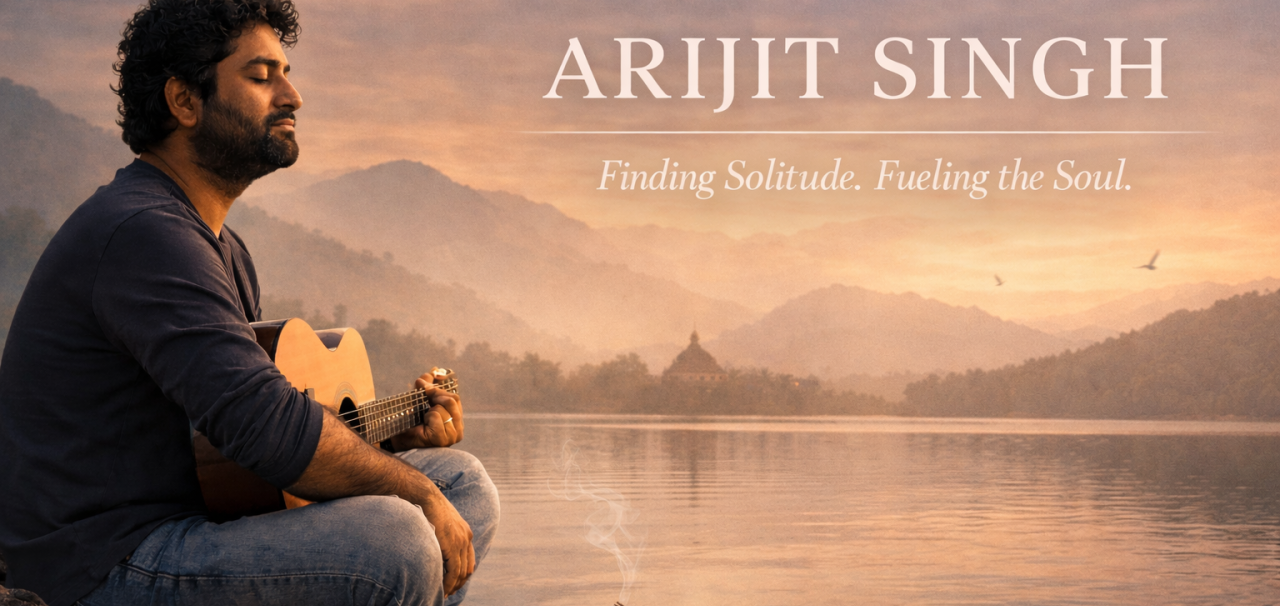
    Arijit Singh—Spotify’s most-streamed artist for seven consecutive years, Ed Sheeran collaborator, a voice with a following that rivals Taylor Swift—announced his retirement from active playback singing. Not because he had to. Because he chose to.

    The industry was stunned. Why leave the peak? He didn’t leave because he was finished; he left because he was starving. He left to feed his classical roots, to touch the “pure music” that commercial success often dilutes. To focus on what matters to his heart and soul, not just his career trajectory. He chose his heart over the hits.

    Brave. Courageous. Revolutionary.

    The Paradox of Success

    Here’s what skeptics miss: “He can afford to do this—he has enough name, fame, and money.”

    Wrong.

    Success operates like sugar and sales—the more you have, the more you crave. The machinery of fame doesn’t slow down; it accelerates. Saying NO at the peak of your powers isn’t easier because you’re successful. It’s exponentially harder.

    That’s precisely what makes Arijit’s decision remarkable.

    He’s not alone in this brave new movement.

    An emerging singer Hardik Dave paused all commercial engagements to focus on Shabd Parikrama—an intuitive, immersive experience that speaks to his artistic soul.

    Zakir Khan, the first Indian to perform in Hindi at Madison Square Garden, stepped into silence to heal his mind —to refresh, reinvent, and sharpen his saw for the next act.

    A pattern is emerging: Stepping back from success is no longer failure. It’s a commitment to reinvent, to rise higher, to go further.

    If Arijit Can, Everyone Can

    Because here’s the truth we avoid:

    Knowing when to walk away

    Knowing when to focus on the next chapter

    Knowing when to listen to your heart

    Knowing when to fuel your soul

    Knowing when to feed the artist within

    It takes guts. It takes restraint.

    The Addiction to Busyness

    Why are we never content?

    Why do we chase everything simultaneously, wearing our busyness as a badge of honor? We accumulate certifications, enroll in every “Top 10” list, binge every trending series. If you actually added up all the “Top 10” things the internet recommends, you’d need several lifetimes to complete them.

    We accept stress, burnout, shallow relationships, and health crises—as long as Instagram validates us with likes.

    How utterly absurd.

    We’ve lost the ability to stand and stare. Our calendars have no white space. Our minds have no room for wonder.

    And we wonder why we’re not creating anything meaningful.

    The Masters Knew Better

    Michelangelo didn’t paint a thousand ceilings; he painted the right one, and it became eternal.

    Van Gogh was prolific yet deeply focused, creating extraordinary work in compressed time.

    Both understood something we’ve forgotten: depth beats breadth. Immersion beats accumulation. Being beats doing.

    “You can do anything, but not everything.” — David Allen

    “The difference between successful people and really successful people is that really successful people say no to almost everything.” — Warren Buffett

    “Starve your distractions, feed your focus.”

    Steve Jobs didn’t create a thousand products. He created a few insanely great ones. He famously said, “I’m as proud of what we don’t do as what we do.”

    If you’re always on autopilot, always busy, always scattered—AI and robotics will gladly replace that version of you. Because that’s not living; that’s executing a program.

    Your First Move

    The gap between knowing and doing is where dreams die.

    So here’s how you bridge it—not someday, not when conditions are perfect, but now:

    1. Name Your North Star

    Not your boss’s goal. Not your parents’ dream. Not society’s checklist. Yours.

    What would you create if no one was watching? What makes you lose track of time? What would you do even if it paid nothing? That’s your North Star.

    During my PhD, everyone expected me to chase publications and conferences. But my North Star was different—I wanted to create frameworks that actually changed how people work. So I blocked Diwali, Christmas, and holidays exclusively for deep thesis work. Three-day sprints for field research. No apologies.

    Your move: Write down three goals that are yours—not borrowed, not expected, not impressive. Just true.

    2. Guard Your Sacred Hours

    All deep work happens in flow states. You can’t schedule flow, but you can protect the conditions that invite it.

    Mozart composed in the early morning. Hemingway wrote at dawn. Maya Angelou rented hotel rooms to escape distractions. They didn’t wait for inspiration—they created the space for it to show up.

    Even today, when I have critical deliverables, I don’t negotiate with distractions. Phone off. Door closed. Calendar blocked. The world can wait two hours.

    Your move: Block one 90-minute window this week. No email. No Slack. No “quick check.” Just you and your craft.

    3. Build Your “Hell No” List

    You already have a to-do list that never ends. Now create the list that actually matters: your Not-To-Do List.

    What will you stop doing? What committees will you quit? What “opportunities” will you decline? What certifications will you skip?

    This isn’t about being lazy. It’s about being ruthless with your finite energy.

    Your move: Write down five things you will say NO to this month. Five meetings, projects, obligations, or distractions. Feel the guilt. Do it anyway.

    4. Turn Doubters Into Believers

    Here’s the secret: You don’t need everyone’s permission. You need your results to speak.

    Communicate your priorities clearly. Then deliver exceptional work in your focus areas. When people see the quality of what you produce, they stop questioning your choices and start championing them.

    Your family might not understand why you’re saying no to gatherings. Your boss might not get why you’re declining projects. But when your focused work produces legendary outcomes, they become your biggest advocates.

    Your move: Tell three people about your focus area this week. Not asking permission—informing them. Then prove it with your work.

    The surest path to failure is saying yes to everything.

    The surest path to mastery is saying no to almost everything.

    The Ultimate Truth

    Here’s what nobody tells you about excellence:

    Excellence is lonely before it’s legendary.

    When Arijit chose inner voice over commercial success, people questioned him. When Jobs killed profitable product lines to focus on the iPhone, the board resisted. When you choose depth over breadth, people will call you impractical.

    Let them.

    Because years from now, they’ll call you visionary.

    Your legacy won’t be measured by how busy you were. It will be measured by what you built when you stopped being busy.

    The urgent always screams louder than the important. Email will always demand attention. Meetings will always multiply. Social media will always beckon. The world will always want a piece of you.

    But your soul? Your art? Your magnum opus? They whisper. And you must learn to hear them above the noise.

    “The cave you fear to enter holds the treasure you seek.” — Joseph Campbell

    That cave? It’s the space between who you are and who you could become. It’s scary because it demands you say NO to good things to say YES to great things.

    Enter the cave.

    The Soul Needs Space

    Focus on depth. Focus on immersion. Focus on being present. Focus on living, not just existing.

    Focus on doing something worthwhile—for the pure joy of the art and heart.

    Focus on making the Earth better, someone’s life richer.

    Focus on taking only what is your due, not everything offered.

    If Arijit can choose his soul over his spotlight, so can you.

    The question isn’t whether you can afford to step back.

    The question is: Can you afford not to?

    The world has enough workers.

    It’s starving for artists.

    Be the artist.

    #Soulware #FocusOnCraft #DeepWork #ArijitSingh #CourageToChoose #LiveWithPurpose #ZakirKhan #Artist